Showing posts with label Pluto. Show all posts

Saturday, July 25, 2015

Pluto

On the evening of July 14, 2015 I took a picture of Pluto to celebrate the flyby of Pluto by NASA's New Horizons spacecraft. But, there was a problem: I couldn't find it!

Pluto is very small, and also very dim. It is typically around 14th magnitude, which is about 128 times dimmer than the human eye can see in Earth's darkest skies. It's not even visible in most amateur scopes, outside of using long-exposure photography. In addition, the part of the sky that Pluto is currently located in is along part of the Milky Way. How was I to locate such a small, dim object among all of those stars?

Plan A was to use my various planetarium programs to find reference stars that would aid in locating Pluto. That failed because none of them had enough stars in their databases to account for everything I was seeing. I made an educated guess (which I discovered was correct), but there was no way to tell for sure until I could implement Plan B.

Plan B was to use a technique similar to that used by Pluto's discoverer, Clyde W. Tombaugh. Tombaugh worked for the Lowell Observatory in the 1920s and 1930s. He would select a part of the sky and take a picture of it with the observatory's 13-inch astrograph (a telescope designed for photography). A few nights later he'd take another picture of the same area. He then used a blink comparator to look for differences between the photographs. Objects that stayed in the same position were stars, but anything that moved was a comet, asteroid, or a planet.

I took my second set of images on the night of July 24, 2015. After processing and lining up the images I was able to see that my suspect Pluto was, in fact, the real thing! The animated GIF below shows Pluto's position on the two nights:

Pluto! Click on the image for a larger view.
To further illustrate how inconspicuous Pluto is, I put together this movie from the July 14th image:


So, there you have it. A mundane little dot moving among a sea of other dots. Who knew what a beautiful little world Pluto would turn out to be?

Public domain image courtesy of NASA and Wikimedia Commons.

Wednesday, July 10, 2013

Pluto

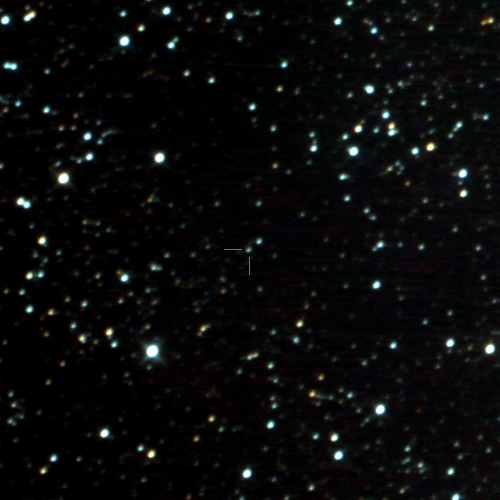
I was digging around in my archives and came across some images of Messier 24 from July 13, 2010. It occurred to me that Pluto would be somewhere within the image, and after some research and searching I managed to find it. It's the "star" at image center, indicated by the blue lines.

Pluto, July 13, 2010; Epsilon-200; Canon EOS Rebel XS (1000); 20x120
Another image from July 17, 2010 is located here.

Monday, August 2, 2010

The Planets, Plus One

Planets are tough to image. They are small, require a great deal of magnification, and often require filters to resolve fine details. Neither the ST80 nor the Epsilon-200 are suited for this purpose. The XT6 Dobsonian is pretty good at resolving planetary details visually for Mars, Jupiter and Saturn. There's not much to see when viewing Venus. Well, there is, but I haven't been able to see much.

I've come up with a trick, though, that lets me image some of the planets with my XT6 Dobsonian. Basically, I mount my Canon PowerShot A590 IS point-and-shoot camera afocally to a 9mm eyepiece (133X magnification). Then, I zoom in the camera to the highest optical zoom setting (4X). This gives me over 500X magnification. The target will move across the field of view very quickly. It takes a lot of work to get decent focus and to get the exposure time just right. The results are not outstanding, but hey, it's a cheap solution!

I've managed to image all eight of the planets, plus Pluto. (I'm not getting into a discussion as to whether or not Pluto is a planet!) Some images are simply shots of the sky, and some are close-up. Here they are in order from the Sun:

Mercury and Venus; DSLR on tripod; March 31, 2010
Venus; XT6; February 15, 2009
Because Venus orbits between us and the sun, we can see it go through phases similar to the moon. Venus is brightest in our skies when it is in a crescent or half phase because it is closer to us than at other times.

Earth; Dish Network; October 25, 2009
I meant it when I wrote "all eight planets!" The Dish Network satellite TV service has a channel called Dish Earth. It broadcasts a view of Earth from the Dish Network satellite in geostationary orbit 24 hours a day.

Mars; XT6; March 27, 2010
This image of Mars was taken about two months after the 2010 opposition. The lighter features at the top and bottom of the disc are the polar caps (north is at top). The darker feature near the bottom is called Tyrrhena Terra. It is a heavily cratered region that contains one of Mars' oldest volcanoes.

Jupiter, Io and Ganymede; XT6; July 4, 2009
The Great Red Spot is clearly visible here. The moons are, from left to right, are Io and Ganymede.

Saturn; XT6; April 02, 2009
This was my third, and best, attempt at imaging Saturn. One of the problems with trying to image with a telescope mounted on an alt-az base is that as objects move across the sky, they appear to rotate in the eyepiece. This effect was particularly pronounced with Saturn. The rings had "rotated" several degrees between the time I started imaging and the time that I stopped!

The following planets were all imaged with the Epsilon-200. The planets are far too small to render much detail within the E-200's field of view, though. My primary reason for imaging them was to simply say that I did it. Plus, I was hoping to catch a few moons, which I did!

Uranus and moons; E-200; July 17, 2010
Neptune and Triton; E-200; July 17, 2010
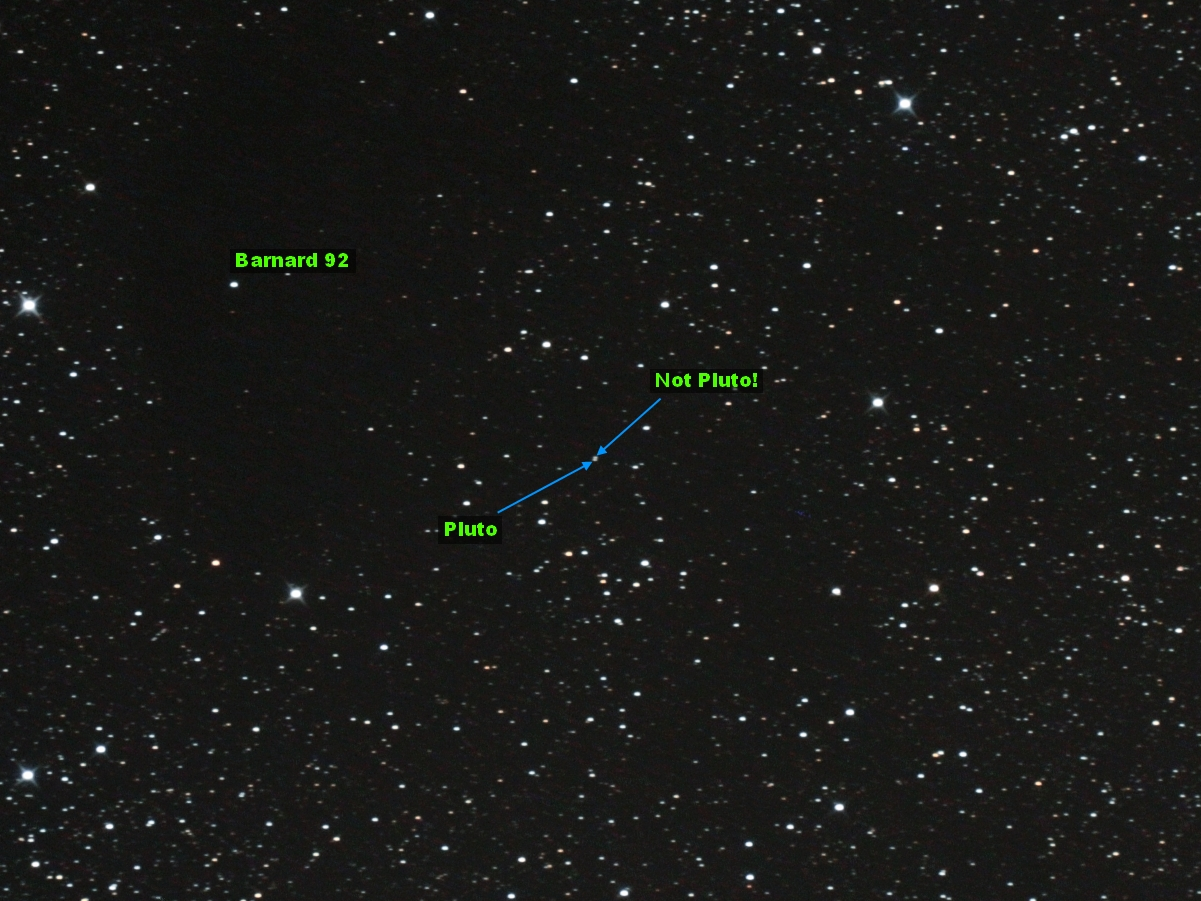
Pluto, near Barnard 92; E-200; July 17, 2010
Pluto passed in front of Barnard 92, a dark nebula, during mid-July 2010. Unfortunately, I missed that event.  I did catch Pluto, though, shortly after it had passed. It is right next to a star. It is easier to distinguish the two in the full-size image.