Showing posts with label Mars. Show all posts

Tuesday, December 22, 2020

2020 Jupiter-Saturn Conjunction

The much anticipated "Christmas Star" conjunction occurred on December 21, 2020. It was visible here at the ObservaRory for a few hours after sunset as clouds moved in and out. My wife and I got to share it with a few neighbors--social distancing was also observed! It was a real Dobsonian event!

To me, the best part of these sorts of things is that it sparks public interest in what is going on above. So many people never seem to look up, but who can really blame them? There is not much to see in the light-polluted skies where most people live.

The downside of these well-publicized events, though, is that they tend to be sensationalized and made out to be something that they are not. For example, a few people were expecting to see a bright star shining down on them like something out of a Christmas movie. The reality was considerably less spectacular, and difficult for some to even identify. Ironically, some people mistook Mars for the Christmas Star because it was more prominent in the sky.

But that aside, this was an event that none of us will see again in our lifetimes.

Well, sort of...

Planetary conjunctions are not that uncommon an occurrence. What made this one special was the apparent proximity of Jupiter and Saturn--it is not often one can fit two planets in the same field of view in a telescope. Objects in the sky have no variation in distance to the naked eye, so even though both planets are physically millions of miles apart, they appeared to be on a collision course from here on Earth. It is an out-of-the-ordinary thing to those who pay attention to the movement of the planets, but probably of little or no interest to individuals who keep their focus elsewhere.

OK, enough of my rambling thoughts. Let's get to some pictures.

Jupiter/Saturn conjunction; AT72EDII; Mallincam SkyRaider w/2X Barlow; SkyWatcher EQ6-R Pro mount; 215 frames; RegiStax 6, Photoshop CS6 (contrast enhancement, cropping)

My scopes are not well-suited for planetary imaging. An experiment that I performed the night before the event yielded disappointing results, so the night of the conjunction I decided to try using a 2X Barlow lens to magnify the scene and reduce the overall brightness. I think it worked out well considering the less-than-ideal circumstances. The Mallincam camera is monochrome, by the way, so none of these images are in color.

I was very happy that the camera picked up cloud bands in Jupiter's atmosphere. The contrast has been boosted but is still very poor because Saturn was not nearly as bright as Jupiter. To the left of Jupiter, and barely visible, are its moons Callisto and Io. Europa is to the right.

Mars; AT72EDII; Mallincam SkyRaider w/2X Barlow; SkyWatcher EQ6-R Pro mount; RegiStax 6, Photoshop CS6 (contrast enhancement and enlargement, cropping)

I slewed over to Mars on a whim, not thinking that I would see much. But, to my surprise, the image results were actually pretty good! I wish now that I had made the attempt to image Mars during the last opposition. I did not write down the number of frames that were stacked, but it was probably more than 100. This image has been enlarged.


Moon; AT72EDII; Mallincam SkyRaider w/2X Barlow; SkyWatcher EQ6-R Pro mount; 248 frames; RegiStax 6, Photoshop CS6 (contrast enhancement, cropping)

Moon; AT72EDII; Mallincam SkyRaider w/2X Barlow; SkyWatcher EQ6-R Pro mount; 215 frames; RegiStax 6, Photoshop CS6 (cropping)

How could I not take some pictures of the moon?

Those very few of you who follow this blog have probably noted my general absence over the past few years. Since the passing of my son, Patrick, my interest in hobbies has waned significantly. I feel, though, that I am starting to turn a corner. With the winter constellations now here, I hope to get back into imaging.


Monday, August 1, 2016

Back Yard Astronomy

The right combination of time, energy, and weather conditions still elude me lately. I haven't done much more than peek out the window at the stars now and then. That gave me an idea, however.

Last night I set up the trusty DSLR at one of the back windows and started making a time-lapse of the sky.

But I didn't account for last night's high humidity. The window fogged up shortly after the sequence was started, and I didn't discover the problem until the morning. There weren't enough frames to make a decent time lapse.

Still, there were a few pictures that I thought were pretty.

Below, the constellation Scorpius, containing the bright red star Antares, dominates the center of the image. Mars and Saturn are visible in the upper-right. Ptolemy's Cluster and the Teapot asterism are on the left. There are clouds, mostly above the treeline, to the right. The Milky Way is visible at the top, just to the left of center. The image at the end of the post has labels.

To the ancient Greeks, the star Antares appeared similar in color and brightness to Mars, which they called Ares. The name Antares means, "rival to Ares" or "equal to Ares." Mars is approaching Antares in the sky, and the two will be less than 2 degrees apart, forming a nearly straight line with Saturn, on August 24, 2016.

Single, 30-second exposure at ISO-1600 made with a Canon EOS Rebel T5 with the stock EFS 18-55mm zoom lens @ 18mm. Corrected for lens distortion and color balanced in Photoshop CS6. Noise reduction using Google Nik Collection Dfine 2.0 Photoshop plug-in.


Thursday, February 26, 2015

Moon/Venus/Mars Conjunction

Clouds. Clouds, clouds, clouds, clouds, clouds, clouds. It's been cloudy lately. A lot. And when it isn't cloudy the humidity is so high you can practically drink the air.

I thought I was going to miss the Moon/Venus/Mars conjunction on February 20, 2015, but the clouds parted just long enough for me to take a few shots. This one is my favorite.

Moon, Venus, and Mars. Venus it the brighter star to the left of the Moon. Mars is the star above and to the right of Venus.
Did I mention that it has been cloudy?

Sunday, November 14, 2010

Looking for Faces in All the Wrong Places

Note:  This is a discussion of the Face on Mars. It will likely make some people angry. I believe that the "face" is a natural feature. This topic has been discussed to death by various individuals on both sides of the argument, but I thought I'd try my hand at it, anyway.


Images are courtesy of the European Space Agency. Yes, I'm using data from an ESA web site to discuss something that NASA did. Go figure.

The human brain is an amazing piece of engineering. Ironically, it is so complex that not even the human mind can't fully comprehend it, but significant progress has been made in decoding some of the brain's mechanical processes.

One of these processes deals with face recognition. Studies have shown that part of the brain's visual processing region, called the fusiform gyrus, is responsible recognizing and categorizing visual information. A specific area in the fusiform gyrus, known as the fusiform face area, seems to be responsible for recognizing human faces. Other studies have shown that this ability is already functioning at birth. Such mechanisms are essential for our survival, and most tend to stick with us throughout our lives.

And that's a good thing. Imagine what life would be like if you couldn't recognize friends, family, or even yourself. Unfortunately, there is such a condition. It's called prosopagnosia, and may involve damage to the fusiform face area.

Conversely, we often recognize faces where there are none. Pareidolia is a phenomenon where we see images and faces in things that are not related to the things we perceive. For example, most of us have recognized the shape of an animal or other thing in a cloud.

This ability has its advantages. It permits us to see through camouflage, pick out faces from a crowd, and produce interesting art.

But, it can easily be carried too far.

Take for example, the infamous Face on Mars.

While taking pictures of potential landing sites in 1976, the Viking 1 probe imaged the Cydonia region of Mars. One of the more intriguing features was a mesa that resembled a human face. As soon as the image became public people began to claim that the image was an artificial construction. It was hard to argue against what the eye was perceiving, though, until NASA was able to get higher resolution images nearly 25 years later.

I thought it might make an interesting exercise to show how the real feature can be mistaken for something that it's not, when the conditions are right.

First, here is the original Viking 1 image from 1976:


Yes, it's small. Actually, I think this is a slightly enlarged version of the original image. The resolution was very low--somewhere in the order of 150 to 300 meters per pixel. The pixels represent two types of things: luminance data, and missing data. Luminance data represents the brightness of the surface being imaged. Combine luminance pixels together and you get a black-and-white image. The missing data is just that: pixels that were lost in transmission.

Below is an image from the Mars Global Surveyor (MGS). This one has been scaled down to save space. A larger version is available here.


Big difference, huh? Well, the resolution of this image is MUCH higher, and the image was taken when the sun was higher in Cydonia's sky. It's still easy to see some parts of the face in the image, but, in my opinion, it certainly doesn't look as much like a face as the Viking 1 image.

For my little exercise, I reduced the MGS image to approximately the same size as the Viking 1 image:


Next, I simulated the shadows from the Viking 1 images by adjusting the contrast:


I thought that the image still had too much detail, so I blurred it a little:


Finally, I attempted to identify the missing pixels on the Viking 1 image and apply them to this image. This gives the face its right "nostril:"


OK, maybe it's not as impressive as the original Viking 1 image, but I think it still proves my point that it is easy to mistake one thing for another.

And this phenomenon isn't limited to just the "I-know-what-I-saw" and the I Want to Believe crowds. Famed astronomer Percival Lowell was convinced that there were canals--and therefore an advanced civilization--on Mars. And more recently one of my favorite astronomers thought he saw the ghost of Lenin on his shower curtain.  (OK, not really, but it sounds funnier that way.)

Still, despite the evidence, some people cling to the idea that the Face on Mars was made by some intelligent force. I admit its more fun to believe in space aliens, fairies, and that Andy Kaufman and Elvis are still alive. But, there are times when we need to face facts and move forward--and hanging onto a fantasy doesn't do anyone any good.

I think, instead, that we should focus our energy on finding out who or what created these interesting Martian features:

http://apod.nasa.gov/apod/ap990315.html
http://www.planetary.org/blog/article/00001314/

Monday, August 2, 2010

The Planets, Plus One

Planets are tough to image. They are small, require a great deal of magnification, and often require filters to resolve fine details. Neither the ST80 nor the Epsilon-200 are suited for this purpose. The XT6 Dobsonian is pretty good at resolving planetary details visually for Mars, Jupiter and Saturn. There's not much to see when viewing Venus. Well, there is, but I haven't been able to see much.

I've come up with a trick, though, that lets me image some of the planets with my XT6 Dobsonian. Basically, I mount my Canon PowerShot A590 IS point-and-shoot camera afocally to a 9mm eyepiece (133X magnification). Then, I zoom in the camera to the highest optical zoom setting (4X). This gives me over 500X magnification. The target will move across the field of view very quickly. It takes a lot of work to get decent focus and to get the exposure time just right. The results are not outstanding, but hey, it's a cheap solution!

I've managed to image all eight of the planets, plus Pluto. (I'm not getting into a discussion as to whether or not Pluto is a planet!) Some images are simply shots of the sky, and some are close-up. Here they are in order from the Sun:

Mercury and Venus; DSLR on tripod; March 31, 2010
Venus; XT6; February 15, 2009
Because Venus orbits between us and the sun, we can see it go through phases similar to the moon. Venus is brightest in our skies when it is in a crescent or half phase because it is closer to us than at other times.

Earth; Dish Network; October 25, 2009
I meant it when I wrote "all eight planets!" The Dish Network satellite TV service has a channel called Dish Earth. It broadcasts a view of Earth from the Dish Network satellite in geostationary orbit 24 hours a day.

Mars; XT6; March 27, 2010
This image of Mars was taken about two months after the 2010 opposition. The lighter features at the top and bottom of the disc are the polar caps (north is at top). The darker feature near the bottom is called Tyrrhena Terra. It is a heavily cratered region that contains one of Mars' oldest volcanoes.

Jupiter, Io and Ganymede; XT6; July 4, 2009
The Great Red Spot is clearly visible here. The moons are, from left to right, are Io and Ganymede.

Saturn; XT6; April 02, 2009
This was my third, and best, attempt at imaging Saturn. One of the problems with trying to image with a telescope mounted on an alt-az base is that as objects move across the sky, they appear to rotate in the eyepiece. This effect was particularly pronounced with Saturn. The rings had "rotated" several degrees between the time I started imaging and the time that I stopped!

The following planets were all imaged with the Epsilon-200. The planets are far too small to render much detail within the E-200's field of view, though. My primary reason for imaging them was to simply say that I did it. Plus, I was hoping to catch a few moons, which I did!

Uranus and moons; E-200; July 17, 2010
Neptune and Triton; E-200; July 17, 2010
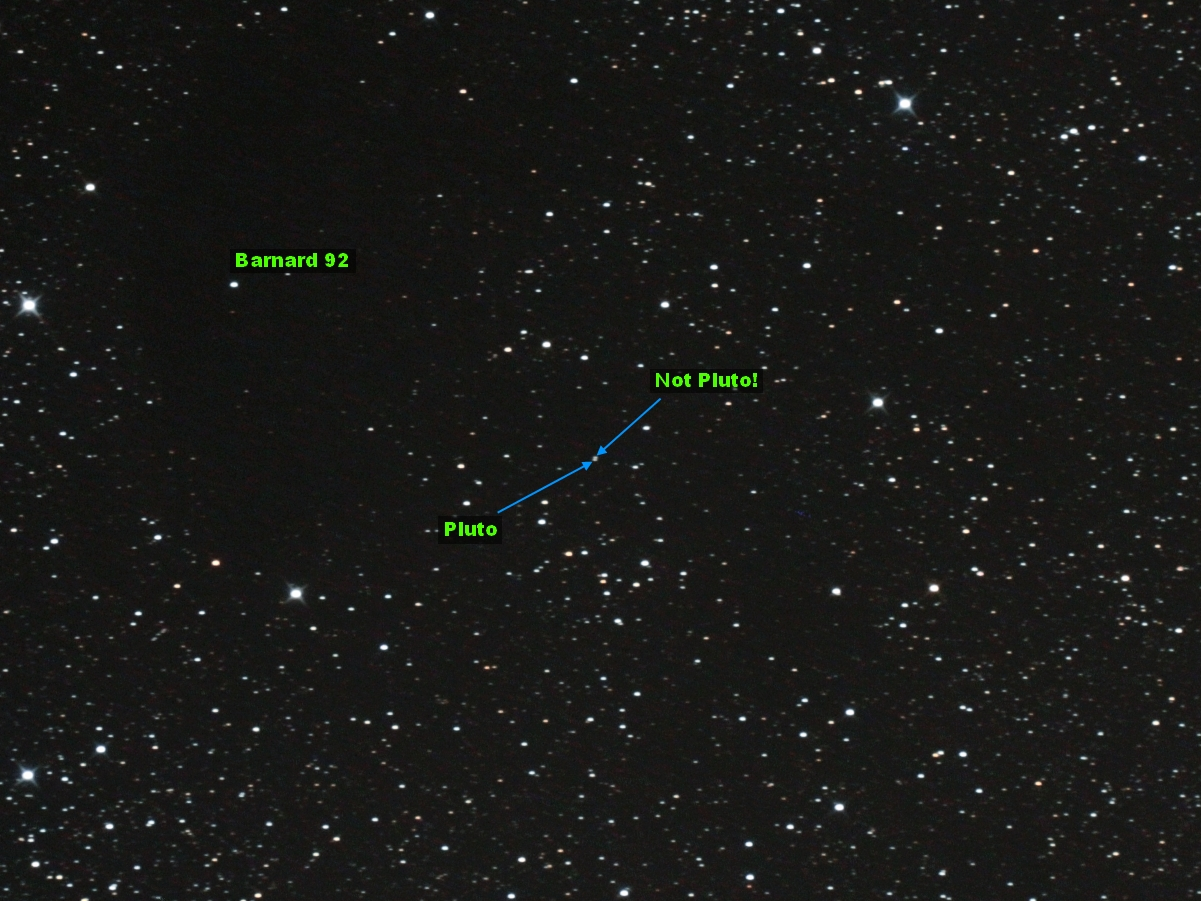
Pluto, near Barnard 92; E-200; July 17, 2010
Pluto passed in front of Barnard 92, a dark nebula, during mid-July 2010. Unfortunately, I missed that event.  I did catch Pluto, though, shortly after it had passed. It is right next to a star. It is easier to distinguish the two in the full-size image.