Showing posts with label Saturn. Show all posts

Tuesday, December 22, 2020

2020 Jupiter-Saturn Conjunction

The much anticipated "Christmas Star" conjunction occurred on December 21, 2020. It was visible here at the ObservaRory for a few hours after sunset as clouds moved in and out. My wife and I got to share it with a few neighbors--social distancing was also observed! It was a real Dobsonian event!

To me, the best part of these sorts of things is that it sparks public interest in what is going on above. So many people never seem to look up, but who can really blame them? There is not much to see in the light-polluted skies where most people live.

The downside of these well-publicized events, though, is that they tend to be sensationalized and made out to be something that they are not. For example, a few people were expecting to see a bright star shining down on them like something out of a Christmas movie. The reality was considerably less spectacular, and difficult for some to even identify. Ironically, some people mistook Mars for the Christmas Star because it was more prominent in the sky.

But that aside, this was an event that none of us will see again in our lifetimes.

Well, sort of...

Planetary conjunctions are not that uncommon an occurrence. What made this one special was the apparent proximity of Jupiter and Saturn--it is not often one can fit two planets in the same field of view in a telescope. Objects in the sky have no variation in distance to the naked eye, so even though both planets are physically millions of miles apart, they appeared to be on a collision course from here on Earth. It is an out-of-the-ordinary thing to those who pay attention to the movement of the planets, but probably of little or no interest to individuals who keep their focus elsewhere.

OK, enough of my rambling thoughts. Let's get to some pictures.

Jupiter/Saturn conjunction; AT72EDII; Mallincam SkyRaider w/2X Barlow; SkyWatcher EQ6-R Pro mount; 215 frames; RegiStax 6, Photoshop CS6 (contrast enhancement, cropping)

My scopes are not well-suited for planetary imaging. An experiment that I performed the night before the event yielded disappointing results, so the night of the conjunction I decided to try using a 2X Barlow lens to magnify the scene and reduce the overall brightness. I think it worked out well considering the less-than-ideal circumstances. The Mallincam camera is monochrome, by the way, so none of these images are in color.

I was very happy that the camera picked up cloud bands in Jupiter's atmosphere. The contrast has been boosted but is still very poor because Saturn was not nearly as bright as Jupiter. To the left of Jupiter, and barely visible, are its moons Callisto and Io. Europa is to the right.

Mars; AT72EDII; Mallincam SkyRaider w/2X Barlow; SkyWatcher EQ6-R Pro mount; RegiStax 6, Photoshop CS6 (contrast enhancement and enlargement, cropping)

I slewed over to Mars on a whim, not thinking that I would see much. But, to my surprise, the image results were actually pretty good! I wish now that I had made the attempt to image Mars during the last opposition. I did not write down the number of frames that were stacked, but it was probably more than 100. This image has been enlarged.


Moon; AT72EDII; Mallincam SkyRaider w/2X Barlow; SkyWatcher EQ6-R Pro mount; 248 frames; RegiStax 6, Photoshop CS6 (contrast enhancement, cropping)

Moon; AT72EDII; Mallincam SkyRaider w/2X Barlow; SkyWatcher EQ6-R Pro mount; 215 frames; RegiStax 6, Photoshop CS6 (cropping)

How could I not take some pictures of the moon?

Those very few of you who follow this blog have probably noted my general absence over the past few years. Since the passing of my son, Patrick, my interest in hobbies has waned significantly. I feel, though, that I am starting to turn a corner. With the winter constellations now here, I hope to get back into imaging.


Monday, August 1, 2016

Back Yard Astronomy

The right combination of time, energy, and weather conditions still elude me lately. I haven't done much more than peek out the window at the stars now and then. That gave me an idea, however.

Last night I set up the trusty DSLR at one of the back windows and started making a time-lapse of the sky.

But I didn't account for last night's high humidity. The window fogged up shortly after the sequence was started, and I didn't discover the problem until the morning. There weren't enough frames to make a decent time lapse.

Still, there were a few pictures that I thought were pretty.

Below, the constellation Scorpius, containing the bright red star Antares, dominates the center of the image. Mars and Saturn are visible in the upper-right. Ptolemy's Cluster and the Teapot asterism are on the left. There are clouds, mostly above the treeline, to the right. The Milky Way is visible at the top, just to the left of center. The image at the end of the post has labels.

To the ancient Greeks, the star Antares appeared similar in color and brightness to Mars, which they called Ares. The name Antares means, "rival to Ares" or "equal to Ares." Mars is approaching Antares in the sky, and the two will be less than 2 degrees apart, forming a nearly straight line with Saturn, on August 24, 2016.

Single, 30-second exposure at ISO-1600 made with a Canon EOS Rebel T5 with the stock EFS 18-55mm zoom lens @ 18mm. Corrected for lens distortion and color balanced in Photoshop CS6. Noise reduction using Google Nik Collection Dfine 2.0 Photoshop plug-in.


Wednesday, July 9, 2014

Moon and Saturn

The Moon passed very near Saturn, from our perspective here on Earth, on the night of July 7, 2014. The image below is a composite of two sets of exposures taken with my Orion ShortTube 80, an Orion yellow #15 filter, and my Canon EOS Rebel T3.

The Moon and Saturn, July 7, 2014.

I used the yellow filter to test how well it might reduce chromatic aberration (CA). I wish I had taken an unfiltered image of the Moon for comparison. My experience has been that in order to get a decent shot of the Moon with my ST80 I need to use the stop down cap, which basically converts the scope from a 80mm f/5.0 to a 43mm f/9.3. CA is reduced, but at the expense of image detail.

This image was taken at 80mm f/5.0, and the red/violet CA was greatly reduced. I also used a technique that I learned to remove most of the remaining CA. I will write an article on that technique in the near future.

The color of the Moon has been enhanced a bit. This normally doesn't work out very well with lunar images on the ST80. I suppose that has something to do with the reduce aperture and CA. I thought it worked out pretty well here, though.

Friday, July 22, 2011

Antique Saturn

This rather poor image of Saturn was taken using a camera phone through the eyepiece of the Alvan Clark & Sons refractor at Sam Houston State University. The telescope was purchased in 1884 by the university (then known as Sam Houston Normal Institute) and sits on its original No. 5 mount. Mike Prokosch, the director of the SHSU Planetarium brought it out after a show one night to view the Moon and Saturn. The views were spectacular! Lunar features were crisp, with high contrast, and I could make out cloud bands on Saturn and the gap between the rings and planet quite easily.

A picture of Mike standing next to the telescope is located on Mike's web site.

Saturn; 1884 4.5" Clark refractor on No. 5 mount; Kyocera Loft camera through 0.6" eyepiece

Monday, August 2, 2010

The Planets, Plus One

Planets are tough to image. They are small, require a great deal of magnification, and often require filters to resolve fine details. Neither the ST80 nor the Epsilon-200 are suited for this purpose. The XT6 Dobsonian is pretty good at resolving planetary details visually for Mars, Jupiter and Saturn. There's not much to see when viewing Venus. Well, there is, but I haven't been able to see much.

I've come up with a trick, though, that lets me image some of the planets with my XT6 Dobsonian. Basically, I mount my Canon PowerShot A590 IS point-and-shoot camera afocally to a 9mm eyepiece (133X magnification). Then, I zoom in the camera to the highest optical zoom setting (4X). This gives me over 500X magnification. The target will move across the field of view very quickly. It takes a lot of work to get decent focus and to get the exposure time just right. The results are not outstanding, but hey, it's a cheap solution!

I've managed to image all eight of the planets, plus Pluto. (I'm not getting into a discussion as to whether or not Pluto is a planet!) Some images are simply shots of the sky, and some are close-up. Here they are in order from the Sun:

Mercury and Venus; DSLR on tripod; March 31, 2010
Venus; XT6; February 15, 2009
Because Venus orbits between us and the sun, we can see it go through phases similar to the moon. Venus is brightest in our skies when it is in a crescent or half phase because it is closer to us than at other times.

Earth; Dish Network; October 25, 2009
I meant it when I wrote "all eight planets!" The Dish Network satellite TV service has a channel called Dish Earth. It broadcasts a view of Earth from the Dish Network satellite in geostationary orbit 24 hours a day.

Mars; XT6; March 27, 2010
This image of Mars was taken about two months after the 2010 opposition. The lighter features at the top and bottom of the disc are the polar caps (north is at top). The darker feature near the bottom is called Tyrrhena Terra. It is a heavily cratered region that contains one of Mars' oldest volcanoes.

Jupiter, Io and Ganymede; XT6; July 4, 2009
The Great Red Spot is clearly visible here. The moons are, from left to right, are Io and Ganymede.

Saturn; XT6; April 02, 2009
This was my third, and best, attempt at imaging Saturn. One of the problems with trying to image with a telescope mounted on an alt-az base is that as objects move across the sky, they appear to rotate in the eyepiece. This effect was particularly pronounced with Saturn. The rings had "rotated" several degrees between the time I started imaging and the time that I stopped!

The following planets were all imaged with the Epsilon-200. The planets are far too small to render much detail within the E-200's field of view, though. My primary reason for imaging them was to simply say that I did it. Plus, I was hoping to catch a few moons, which I did!

Uranus and moons; E-200; July 17, 2010
Neptune and Triton; E-200; July 17, 2010
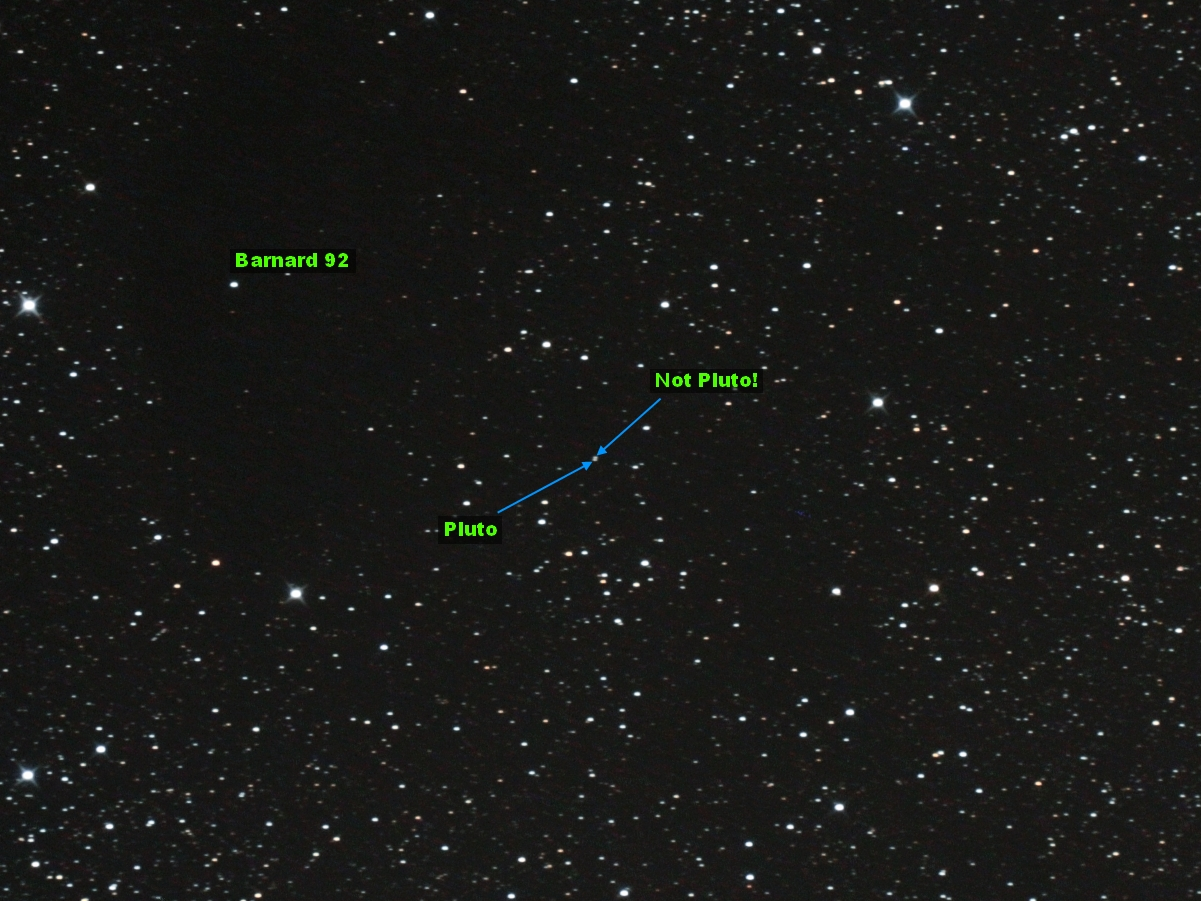
Pluto, near Barnard 92; E-200; July 17, 2010
Pluto passed in front of Barnard 92, a dark nebula, during mid-July 2010. Unfortunately, I missed that event.  I did catch Pluto, though, shortly after it had passed. It is right next to a star. It is easier to distinguish the two in the full-size image.