Planets are tough to image. They are small, require a great deal of magnification, and often require filters to resolve fine details. Neither the ST80 nor the Epsilon-200 are suited for this purpose. The XT6 Dobsonian is pretty good at resolving planetary details visually for Mars, Jupiter and Saturn. There's not much to see when viewing Venus. Well, there is, but I haven't been able to see much.
I've come up with a trick, though, that lets me image some of the planets with my XT6 Dobsonian. Basically, I mount my Canon PowerShot A590 IS point-and-shoot camera afocally to a 9mm eyepiece (133X magnification). Then, I zoom in the camera to the highest optical zoom setting (4X). This gives me over 500X magnification. The target will move across the field of view very quickly. It takes a lot of work to get decent focus and to get the exposure time just right. The results are not outstanding, but hey, it's a cheap solution!
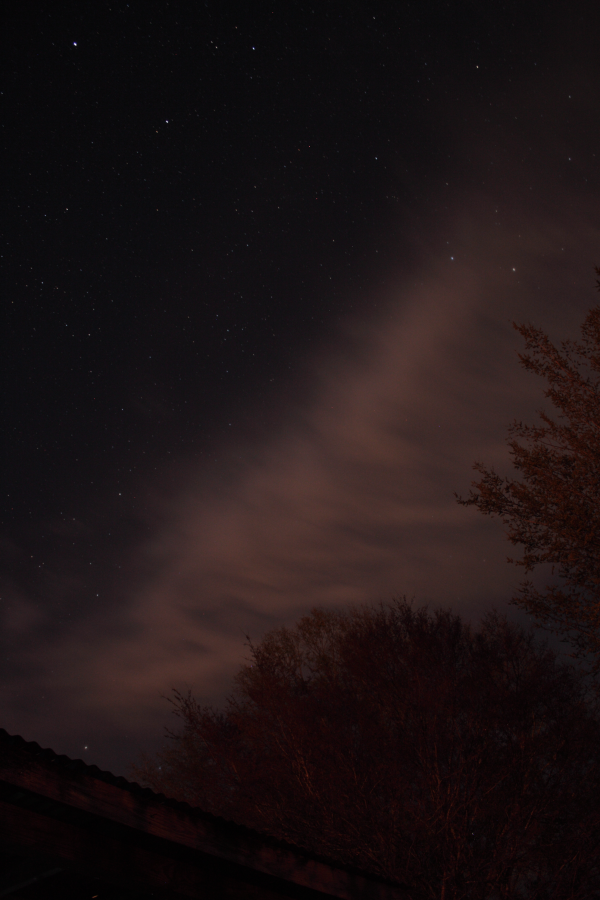
I've managed to image all eight of the planets, plus Pluto. (I'm not getting into a discussion as to whether or not Pluto is a planet!) Some images are simply shots of the sky, and some are close-up. Here they are in order from the Sun:
 |
| Mercury and Venus; DSLR on tripod; March 31, 2010 |
 |
| Venus; XT6; February 15, 2009 |
Because Venus orbits between us and the sun, we can see it go through phases similar to the moon. Venus is brightest in our skies when it is in a crescent or half phase because it is closer to us than at other times.
 |
| Earth; Dish Network; October 25, 2009 |
I meant it when I wrote "all eight planets!" The Dish Network satellite TV service has a channel called Dish Earth. It broadcasts a view of Earth from the Dish Network satellite in geostationary orbit 24 hours a day.
 |
| Mars; XT6; March 27, 2010 |
This image of Mars was taken about two months after the 2010 opposition. The lighter features at the top and bottom of the disc are the polar caps (north is at top). The darker feature near the bottom is called Tyrrhena Terra. It is a heavily cratered region that contains one of Mars' oldest volcanoes.
 |
| Jupiter, Io and Ganymede; XT6; July 4, 2009 |
The Great Red Spot is clearly visible here. The moons are, from left to right, are Io and Ganymede.
 |
| Saturn; XT6; April 02, 2009 |
This was my third, and best, attempt at imaging Saturn. One of the problems with trying to image with a telescope mounted on an alt-az base is that as objects move across the sky, they appear to rotate in the eyepiece. This effect was particularly pronounced with Saturn. The rings had "rotated" several degrees between the time I started imaging and the time that I stopped!
The following planets were all imaged with the Epsilon-200. The planets are far too small to render much detail within the E-200's field of view, though. My primary reason for imaging them was to simply say that I did it. Plus, I was hoping to catch a few moons, which I did!
 |
| Uranus and moons; E-200; July 17, 2010 |
 |
| Neptune and Triton; E-200; July 17, 2010 |
 |
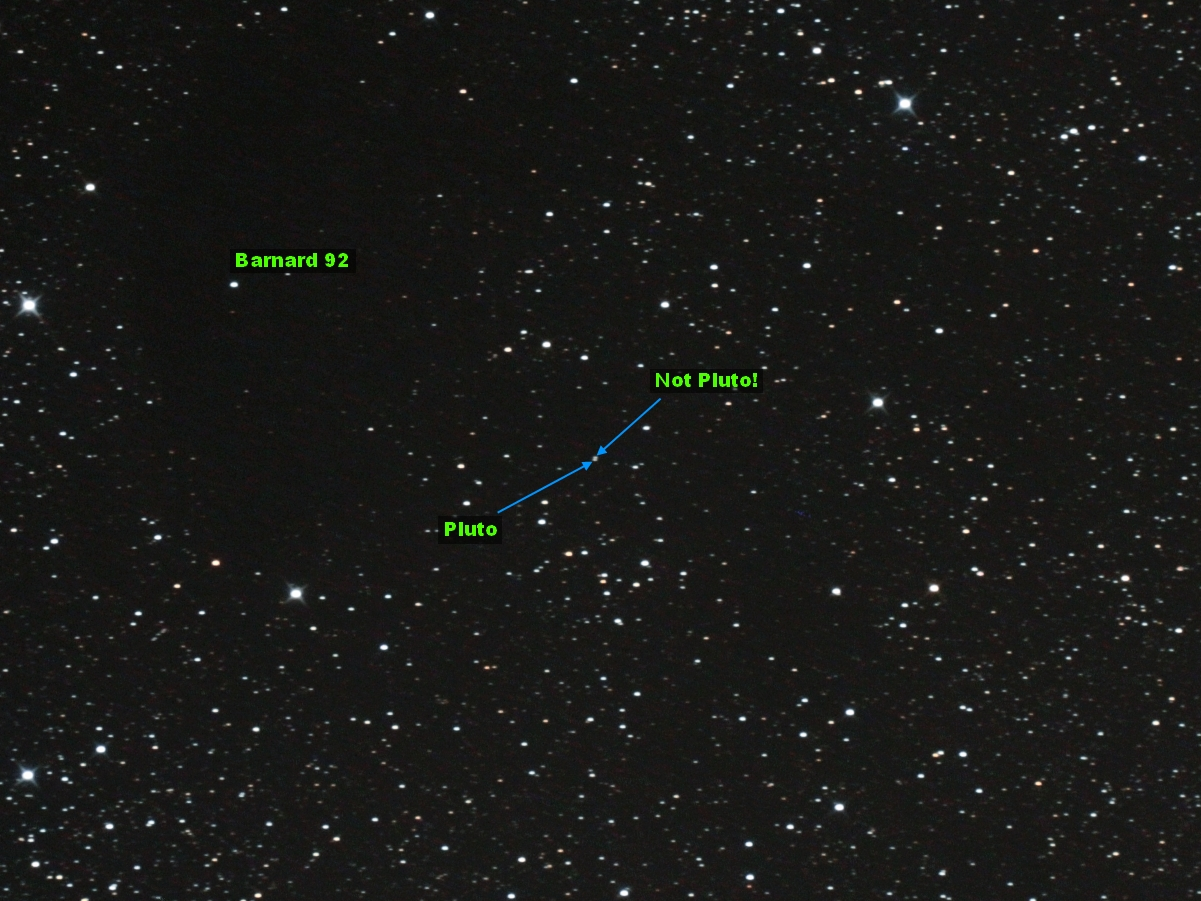
| Pluto, near Barnard 92; E-200; July 17, 2010 |
Pluto passed in front of Barnard 92, a dark nebula, during mid-July 2010. Unfortunately, I missed that event. I did catch Pluto, though, shortly after it had passed. It is right next to a star. It is easier to distinguish the two in the full-size image.