Showing posts with label Sun. Show all posts

Tuesday, December 25, 2018

The Sun and Moon at Matagorda

My wife and I made another trip to Matagorda Beach, just a few days before Christmas 2018. Among the many beautiful sights were a gorgeous sunset and moonrise the day after the 2018 Winter Solstice.

This left-hand sun dog appeared in the clouds in the early afternoon and stayed until nearly sunset.

Left-hand sun dog near sunset.
When there is a clear view of the Sun setting at the horizon, atmospheric distortion can create a phenomenon called a "green flash." The effect may last for a second or two. I managed to capture one in several images. The best one is below (note the green along the top edge of the Sun).

Green flash at sunset. The pier is located at Jetty Park.
Note the couple walking along the beach in the foreground.
Sunset
Then the Moon rose! Clouds blocked the view at the horizon, but the view was spectacular once it got high enough.

"Cold Moon" full moonrise
Cars exiting the beach at moonrise.
And finally, paraphrasing George Bailey from It's a Wonderful Life:
You want the moon? Just say the word and I'll throw a big lasso around it and pull it down. Hey, that's a pretty good idea! I'll give you the moon, Kristi!

Sunday, May 6, 2018

International Space Station in H-Alpha

Ever since I made the images and video of the ISS solar transit at Huntsville State Park, I have wanted to do the same thing using an H-Alpha solar telescope. The right combination of location, weather, and available time came together on May 6, 2018, so I borrowed a Coronado PST and headed to Davy Crockett Memorial Park in Crockett, Texas.

The transit occurred at 11:27:44 AM, and lasted about six tenths of a second. Considering it took nearly an hour to drive to the site and then almost a half hour to set up, this seemed like a small reward for the effort. But, it was very satisfying to see the space station race across the face of the Sun literally seconds after I had finished setting up and focusing the scope.

Composite of 11 separate images, combined and colorized in Photoshop CS6.

A 300% zoom of one of the better images in the series, showing some of the structural details.


Telescope: Coronado PST
Mount: Vixen Super Polaris
Camera: Mallincam SkyRaider AG
Processing: MALLINCAMSKY, PIPP, Photoshop CS6

Monday, August 21, 2017

Solar Eclipse 2017

The Big Day finally arrived!

I was out in the yard at 5:15 AM, accompanied by my very confused cats, to set up and polar align the Vixen Super Polaris mount.

My younger son stayed home from school to view the event (and play video games). The sky looked good. The equipment was ready. We went to the store to buy fresh batteries for the mount, then...

clouds

Yes, I wrote it. The "C" word. The bane of astronomers, both amateur and professional, everywhere.

I'd been looking forward to this day for years. In fact, I was already disappointed that I wouldn't be able to travel to see totality. But this...

This.

It's not unusual to have early morning clouds during humid, East Texas summers. But the timing...

But we amateur astronomers are an optimistic bunch. In fact, astronomy is one of the few things in which I embrace optimism to any degree. It's not in my personality to expect the best. However, I've been known to sit under overcast skies with the belief that, eventually, they will part and the skies will be clear. Sometimes I'm right. Too often, I'm wrong.

Still, I pushed forward and finished setting up the rig.

A couple of minutes after first contact (the point at which the Moon begins passing in front of the Sun), the clouds started to break up. I won't say that it was smooth sailing from that point forward, but as the day progressed the clouds became less of an issue.

The neighbor's landscaping crew, however, chose today to mow her lawn. Imaging had to be shut down temporarily to protect the equipment from dust.

I couldn't get the ST80 and PST to play nicely together, so I just concentrated on using the PST.

Most of the images made with the PST below are stacked images, meaning they are composed of several individual images that were digitally combined to improve detail and sharpness.

Anyway, I guess I've wasted enough of everyone's time talking about it. Let's get to the pictures!

First up, here is the rig in its final form, doing its job. I cobbled together a sun shield for the laptop out of a cardboard box. A laptop cooling pad and ventilation holes in the box kept the computer cool and comfortable.


I also made a simple pinhole projector camera. Here, my son is holding the paper while we look at the image.


A colander also makes a decent pinhole projector, with an interesting pattern:

This image was taken during the peak of the eclipse from my location.
This is one of the earliest images that I could obtain due to the clouds:


I never found a way to eliminate the Newton rings, or whatever the bands across the Sun are.

Incidentally, I'm using a different shade of yellow now--a little closer to the color of the Sun in my white light filter. (Since I'm using a monochrome camera, the original images are in black and white.)

In this image, sunspot group AR 2176 has been completely covered.


Nearing the peak! The Sun is smiling and has something stuck in its teeth.


This image is a composite between two exposures taken near the peak: a shorter exposure to get the detail on the Sun's disc, and a longer one to highlight the relatively dimmer prominences (the streams of plasma seen along the outside edges). The two images were combined in Photoshop. Each image is a single shot (not stacked).


This image was taken a little later, but composed of stacked images. Note the greater detail on the surface and in the prominences.


Here, the Moon is almost past the Sun. I somehow managed to accidentally switch the camera to a lower resolution, so this image is smaller than the others.

I like to call this one The Death Star.

Other than a small swarm of love bugs, there weren't as many visitors in the images as there were during the Venus Transit. However, a few vultures flew overhead near the end, and one got caught on camera:


It was a fun day, and I'm glad the weather held out enough to see the majority of the show. The next total solar eclipse in North America will happen in 2024. I can't wait!

Sunday, August 20, 2017

Another Sun Test

So, yesterday's test was a success, overall. Today I decided to try to address the banding and temperature issues.

The bands in the previous image are likely Newton's rings, based on what I have read. The Coronado PST reduces the light it receives down to a single wavelength (or pretty close to it). There is probably a misalignment somewhere in the optical train that is causing a reflection. The reflected light bounces around, and since light travels as a wave, the crests and troughs sometimes meet up--crest + crest, trough+trough, and crest+trough--amplifying or cancelling the light. The Wikipedia article probably explains it better.

Anyway...

I attempted to apply a flat field in the hope that it would reduce the effect. It did not work. I have run out of time, so the images tomorrow will just have to be wavy.

The temperature problem, however, may have been solved. I modified an old reflective windshield shade to fit over the scopes and cameras. The temperature inside the shield was almost 30 degrees less (96F) than direct sunlight (125F). The ambient temperature at the time was 96F.

I spend a great deal of time (and frustration) trying to mount the ST80 and PST together, like I did back during the Venus Transit. A problem that I had then, that I was attempting to solve this afternoon, was that the two scopes do not line up perfectly. The Sun will be visible in one, but either out of view or on the edge of view in the other. Unfortunately, despite a couple of frustrating hours working on it, I was unable to solve this problem.

My priority will be on the PST images, with a few white light images here and there.

Now, on to the pictures!

Here are the two scopes on the mount with their heat shield:

The Mallincam SkyRaider is on top, in its own custom heat shield sleeve.


It was getting late by the time I finished with everything else and started testing the rig. So, I only had time for a few shots before the Sun went behind a tree. Below is a composite image that combines the surface with some prominences that were visible on the solar limb. The original images were monochrome (black and white). I colorized them since, you know, the Sun is supposed to be yellow.

Sunspot region AR 2671, located near the center of the Sun's disc, looks a little like Santa's sleigh, doesn't it?

And, finally, here is a white light test image taken with the ST80:

Another sunspot group is coming around the limb on the left side of the image. I do not know what its number is at present.
Enjoy tomorrow's eclipse, and wish me luck!

Saturday, August 19, 2017

Sun Test

Below is an image of the Sun from a test run using the Mallincam SkyRaider on a Coronado PST. Even though this scope is not specifically designed for photography, it worked well with the SkyRaider.

I don't know what is causing the banding across the image, though...

I found out that the bands in the image are called Newton's rings, which are caused by interference patterns in monochromatic light. They are very common in narrow band imaging with these types of cameras. If I have time tomorrow I will experiment with some techniques I read about to eliminate or reduce them.


Here is a close-up (slightly enlarged) of AR 2671, the sunspot region visible near the center.


Saturday, July 15, 2017

International Space Station

If you are in the right place at the right time you might be able to catch a glimpse of the International Space Station (ISS) as it passes in front of the Sun or Moon. These types of events are called "transits" and are fairly uncommon.

Transits are hard to see and easy to miss. The ISS orbits between 205 and 255 miles above the surface of the Earth, and moves at over 17,000 miles per hour. At that distance and speed, lunar and solar transits only last about one second or less and are only visible from a relatively narrow strip of land on the Earth's surface.

But finding a good viewing spot and time is relatively easy with ISS Transit Finder. This site lets you specify an area and a date range, and will calculate when and where the ISS will pass in front of the Sun or Moon.

A solar transit occurred on July 14, 2017. The center of the centerline of the transit was located in Lake Raven in Huntsville State Park, which is not far from where I live. I set up the ShortTube 80 with a full-aperture glass solar filter along the shore of the lake, and caught the transit using the Mallincam SkyRaider camera. Here is a composite image of the transit:

International Space Station transit of the Sun, July 14, 2017. Sunspot group AR2665 is located on the right.

The frame rate of the camera was not consistent, which is why there are gaps in the image sequence. The original monochrome images have been colorized to approximate the view through the solar filter.

The following video shows the transit in fairly close to real-time. Note that there are TWO transits! The first is probably an insect that either flew in front of the telescope or crawled across the objective lens.


On a side note, one of the lessons that I learned from the Venus Transit was that good polar alignment is critical for good results. This is difficult to do in the daytime, though, unless the mount has some kind of "magic" hardware and software for figuring out its exact position. My '80s-tech Vixen Super Polaris EQ mount does not have any fancy alignment features, but I was able to get a decent polar alignment using my mobile phone.

I plan on trying to image more ISS transits in the future when the opportunities arise. I would really like to get a lunar transit now.

Saturday, May 14, 2016

2016 Mercury Transit

The Mercury transit...

Well, I almost missed it. Most of Texas (and the United States, for that matter) was socked in with clouds. The few places that were clear were too far for me to travel.

But amateur astronomers almost always hold on to at least a little bit of hope, even when the odds are overwhelmingly against us. We patiently scan the sky for "sucker holes" and engage in our preferred ritual superstitions to drive away the clouds. (Yeah, I know, we're supposed to be scientific and all that...but desperate circumstances often lead to desperate actions.)

The sky DID clear up for a few minutes--at least enough for me to focus and get a few shots in. It's nothing spectacular, but here it is:

Click here for the full-size version.

Mercury is the dot to the upper-right of center. The big sunspot group to the left is AR2542. Other smaller sunspot groups are also visible.

This is a stack of four exposures, each 1/2000th of second at ISO-100, taken with a Canon T3 on my Orion ShortTube 80. I used an Orion full-aperture solar filter, and the Baader Contrast Booster (to reduce chromatic aberration). The images were stacked and wavelet sharpened in RegiStax5. I did an "auto color" correction in Photoshop CS6 to brighten the image a bit.

Click here to see my images of the 2012 Venus transit.

Sunday, March 20, 2016

2016 Spring Equinox

Here is a portrait of my family about 15 minutes before sunset on the Spring Equinox. Our road runs east/west, so the sun rises and sets at the ends on the equinoxes. I've dubbed the street "Roadhenge."

Rite of Spring at Roadhenge

Thursday, October 23, 2014

October 23, 2014 Solar Eclipse

A few of us from the Huntsville Amateur Astronomy Society set up scopes on the roof of the Sam Houston State University parking garage. There were over 200 in attendance. While the emphasis was visual observation, I managed to snap a few shots.

In addition to the eclipse, giant sunspot group AR2192 was a big hit with the crowd.

These first two were taken at prime focus with my Canon EOS Rebel T3 through the ST80 with the solar filter:


This image was taken afocally through an 8-inch Meade Schmidt-Cassegrain with my Samsung Galaxy S5 Active:

This image was processed a bit to remove smudges on the eyepiece lens.


Monday, September 23, 2013

Autumn Equinox 2013

The road in front of my house runs east-west, so I thought I'd try one of those sunrise or sunset equinox pictures. Today was the first full day of autumn in East Texas. The sky was overcast at sunrise, but I was able to get these pictures about 20 minutes before sunset.

Looking West shortly before sunset.

Looking East, casting a long shadow.

Sunday, June 30, 2013

Sun

It's been a while since I've done any solar imaging. I found that I enjoyed imaging in Hydrogen Alpha when I was preparing for the Venus Transit last year, but I don't have the right equipment. I borrowed a Coronado PST this weekend and managed to get a few images between the clouds.

All three images were made using the Coronado PST. The first two were imaged with a Meade DSI camera, and the third was imaged with a Canon EOS Rebel T3 (1100D). I was able to capture a separate set of images for the solar disk in the first image, which is why the details are more pronounced than in the second image.

Solar Prominences

Solar Prominences

The full disk of the Sun, taken with my DSLR.

Thursday, June 7, 2012

2012 Venus Transit

On June 5, 2012, the planet Venus passed directly between the Earth and the Sun for the last time until the year 2117. The weather here was favorable for viewing the first half of the transit. It was an amazing sight, and I'm very happy that my family and I got to see it!

Mike Prokosch and I set up our scopes on the grounds on the Texas Prison Museum and invited the public to come see the event. Here are some images that I took with my setup:

Hydrogen Alpha Images:


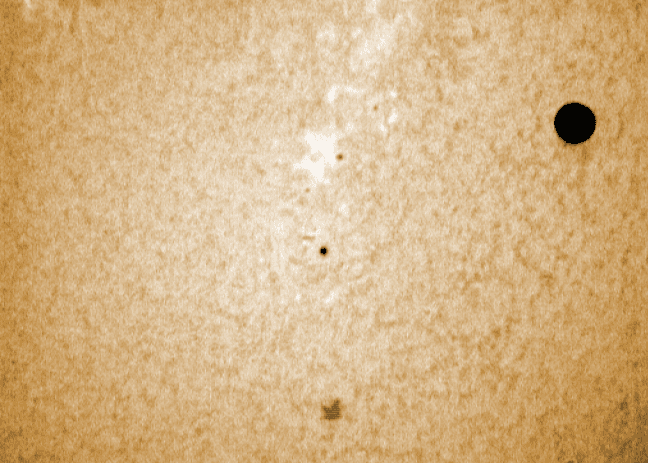
I used the Coronado PST and Meade DSI camera to capture these images of the Sun in the Hydrogen Alpha wavelength.

Shortly after Contact I.
Right around Contact II.
My personal favorite out of all of the images. Sunspot groups 1493 and 1496 are visible  on the left.
Sunspot 1494 is on the far left.

Full-Spectrum Images:


These image were taken with a Canon EOS Rebel XS (1000D) attached to an Orion ShortTube 80 equipped with a solar filter.


Artsy Images:


Interesting Visitors


The following three images are single frames that captured other items besides the Sun and Venus. The first two show doubles, which gives some insight into how the Meade DSI camera works:  it scans the odd- and even-numbered rows separately, allowing fast-moving objects to show up twice as they move across the field of view. Each of these images has been processed to make the transiting objects appear more solid.

Airplane. The contrails are visible as distortions behind the aircraft.
Bird, located below the sunspot that is near the center, and again to the right and slightly down.
Bird, at center, near the bottom.

Sunset:


Monday, May 28, 2012

Practice Image

I had a little time this afternoon to practice solar imaging--probably my last attempt before the Venus Transit, next week.

Sunspot groups 1492 (left) and 1490 (right).

Here is my imaging setup. The Coronado PST is piggybacked onto the ST80. A solar filter on the ST80 allows me to take visible-light images of the Sun with a DSLR.


Sunday, April 22, 2012

Active Sun - 4/21/2012

Sunspot groups 1463 (barely visible near the limb, left), 1462 (left of center) and 1459 (upper-right).

Sunspot group 1465

Sunspot groups 1459 (upper-left) and 1460 (lower-right)

Detailed view of sunspot groups 1459 and 1460

Sun in the visible spectrum, April 21, 2012.