Showing posts with label globular clusters. Show all posts

Sunday, March 29, 2015

Messier 51 and Omega Centauri

The sky has been clear for the past few nights, and last night I finally got some observatory time! Most of the night was spent helping another amateur astronomer with his scope and making adjustments to the Epsilon-200, but I did get a little bit of time for imaging. The first, an image of the Whirlpool Galaxy, was created from a series of test shots. The focus is a little off, and some of the fainter detail didn't show up because of a bright moon (68% illumination). Despite the problems this image is actually better than my previous attempts. I did not shoot dark, flat, or bias frames.

Messier 51, the Whirlpool Galaxy; Epsilon-200 on NJP; Canon EOS Rebel T3; 8x180 @ ISO-1600
Globular cluster Omega Centauri is a monstrous cluster that appears very low on the horizon (about 11 degrees at most) from my latitude. I've seen it visually once, and have wanted to image it for years.

The problem is that it is only visible for a few minutes from where the Epsilon-200 is located at the SHSU observatory. I imaged it as it passed between a couple of trees at the the south end of the observatory. Seeing is bad that low down, and it is within the light domes of several cities.

Omega Centauri; Epsilon-200 on NJP; Canon EOS Rebel T3; 33x30 @ ISO-1600

Sunday, July 7, 2013

Observatory

The southern sky from my house is dominated by the light dome of Huntsville. One of the nice things about the Sam Houston State University observatory is its relatively dark southern sky; so, when I get a chance to image from the observatory I often image objects to the south.

During a recent visit to the observatory I imaged Messier 22, a globular cluster, and Messier 17, the Swan Nebula. Both objects are located in the constellation Sagittarius.  Both images were made with my ST80 and the Vixen Super Polaris mount.

Messier 22, the Sagittarius Cluster; ST80 on a Vixen SP mount; 17x120
I posted an image of Messier 22 back in August 2010 that was made using the Epsilon-200.

I was trying some experiments with a Barlow lens and apparently knocked the mount out of alignment.  I didn't realize the problem until I started imaging Messier 17. I tried realigning it, but apparently didn't do something right. It was getting late and I was getting tired and making mistakes. However, I did manage to get five decent subs of the nebula.
Messier 17, the Swan Nebula; ST80 on a Vixen SP mount; 5x120
I've imaged Messier 17 before. I will definitely revisit this object when I get a chance.

Monday, July 1, 2013

Messier 5

Messier 5 is a globular cluster in Serpens Caput (the Serpent's Head). It is one of the brighter globulars and is visible to the naked eye from dark locations.

For for those of you who are only interested in seeing the picture, here it is. Boring details about the imaging session are below. :)

Messier 5; ST80 on Vixen SP; 10x120 at ISO-800
Last night had nearly ideal viewing conditions, and I like to take any opportunity that I can to do some imaging or viewing, even if it's only for a short time. Fortunately the mount was already set up from the solar imaging session earlier that day, so I decided to work on improving my alignment skills.

Messier 5 was a good target for testing since it is fairly bright and was located near the celestial equator. As I've stated before, I use an old Vixen Super Polaris mount that was probably manufactured in the mid-1980s. The mount's polar alignment scope has an outdated reticle with a circle in which one is supposed to center Polaris. The circle is intersected by another circle that is drawn 48' from the center of the reticle, which represents the North Celestial Pole.  The position of Polaris has changed significantly due to precession, so I've had to estimate where to place Polaris in relation to the markings on the reticle. Until last night my attempts have been anywhere from bad to not quite so bad.

I downloaded an app named Polar Finder for my Android phone. It features an iOptron reticle that makes it easy to pinpoint where Polaris should be in my Vixen finder scope. I estimated the location in the reticle, aligned the mount, and then took 23 two-minute exposures.

The results were pretty good! There was a little bit of drift, but the main problem was just periodic error, which I have no control over, anyway. The image below is a combination of all of the exposures made in Startrails. It illustrates how much the mount moved off target during the session.

23 images combined in Startrails, showing the effects of periodic error and misalignment.
The stars are streaked up and down due to periodic error. I expected to see something more like the oscillations captured during the 1998 QE2 imaging session, but apparently the alignment was very good. I think that the small "hook" to the right was due to vibration or wind affecting the mount. I'm looking forward to trying this again and taking long exposures on some galaxies and nebulae!

Tuesday, July 31, 2012

Messier 15

I finally got some time on the Takahashi Epsilon-200 the other night. The NJP mount was in need of some minor repair and readjustment. With the help of a couple of my astronomy pals we got everything put back together, balanced and aligned. The mount did very well, although I think the autoguiding needs a bit more tweaking.

Messier 15, in the constellation Pegasus, was one of the few globular clusters that night that were bright enough to shine through the moonlight.

This is a composite of 15-, 30-, 60- and 120-second exposures.

Messier 15; Epsilon-200 on NJP; 10x15+10x30+10x60+12x120

Monday, September 5, 2011

A Love-Hate Relationship

I have a love-hate relationship with the telescope mount that I use at the observatory. For reasons that I have yet to determine, it works very well sometimes and not so great other times. I will spend several hours trying to tweak the thing and the results will be mediocre, which is a shame considering that this is supposed to be a high-end mount.

Maybe it's me, but on the other hand I can set up my little Vixen SP mount with the ST80 and get very good results with a minimum of fuss. (One major difference, though, is that the ST80 has a much wider field of view, and so is a little more forgiving of tracking errors.)

Anyway, I finally got to spend some time working with the Epsilon-200 after a long hiatus. I battled the mount, which apparently thought it was on another planet, for a couple of hours and managed to squeeze in about two hours of imaging. All of my intended targets had either set or crossed into the light pollution of Huntsville (why didn't I use the light pollution filter???), so I picked the following items to image:

Messier 2, Epsilon-200 on NJP mount, 16x60 + 8x30
Messier 29, Epsilon-200 on NJP mount, 13x90
NGC 6992, the Eastern Veil; Epsilon-200 on NJP mount; 9x180
Addendum:  The right ascension motor had come loose on one side, resulting in the tracking errors that plagued me the night that I took the above images. The problem became obvious while slewing the scope during a star party--the dust cover that protects the gears began scraping one of the gears as the motor slipped further down. After reattaching the motor and balancing and aligning the scope, everything started working fine.

Tuesday, April 19, 2011

Heart of the Scorpion

Antares is a supergiant star in the constellation Scorpius. It is nearly 300 million miles across, which is larger than the orbit of Mars! Antares is sometimes called the "Heart of the Scorpion."

The area in the sky around Antares is full of exciting objects. I imaged a small part of it while waiting for M8/M20/M21 to rise one morning. I took only a few images, but after heavy image processing I came up with the following:

Antares, Messier 4, NGC 6144 and IC 4605; ST80 on Vixen SP; 6x180
Antares is the yellow star at the bottom of the image. It appears orange to the naked eye. The yellow color here is due to the fact that the star is overexposed, and the camera is less sensitive to the red part of the spectrum.

Clouds of interstellar gas and dust fill the area, adding unusual patterns and colors to the scene.

Messier 4 is the large globular cluster at the top. It is about 7,200 light years away and is one of the closest globular clusters to Earth. Messier 4 is also called the Cat's Eye cluster because of the conspicuous bar structure across the middle.

Globular cluster NGC 6144 is located to the upper-left of Antares. It is about 33,000 light years away.

The blue reflection nebula IC 4605 is in the lower-left corner.

I plan on revisiting this and the surrounding area one day. There is a lot more to see!

Friday, April 15, 2011

A Lagoon, a three-lobed cloud, and a bunch of stars!

Sagittarius is one of my favorite constellations. It is full of interesting things to see: open clusters, globular clusters, nebulae and the Sagittarius Star Cloud. It is also the location of the galactic center.

The image below is a composite of two separate shots. The large nebula on the right is Messier 8, the Lagoon Nebula. It is a bright star forming region, and is visible to the naked eye even in somewhat light polluted skies. The red glow comes from hydrogen gas that is being energized by ultraviolet radiation from the stars that are forming within the nebula. The process that causes this is similar to the process that causes fluorescent lights to glow.

The small nebula near the upper-left is Messier 20, the Trifid Nebula. The same process that causes the Lagoon Nebula to glow red is at work in the red portion of the Trifid. The blue color comes from starlight that is being reflected off of gas and dust. Trifid means "divided into three parts," in reference to the dark lanes that divide the red portion.

Messier 21 is the open cluster on the left side of the image.  And, located in the lower-right corner is globular cluster NGC 6544.

Messiers 8, 20, 21, and NGC 6544 in Sagittarius; ST80 on Vixen SP

Wednesday, April 13, 2011

Messier 13, the Great Globular Cluster in Hercules

Messier 13, also known as the Great Globular Cluster in Hercules, is the brightest globular cluster in the northern hemisphere. It is a little over 25,000 light years away, about 145 light years in diameter, and contains hundreds of thousands of stars. M13 is visible to the naked eye on dark, clear nights away from city lights.

Messier 13; ST80 on Vixen SP; 16x120
Spiral galaxy NGC 6207 is visible near the lower-left corner of the image. Also visible in this image (barely) is spiral galaxy IC 4617. It is located about halfway between the center of M13 and NGC 6207, next to a pair of stars.

Messier 13 was chosen as the target for the Arecibo message of 1974. The message was a single (non-repeated) transmission of binary data that, when decoded, provided various details about Earth and humankind. It was not meant to be a serious attempt at contacting extraterrestrial life, though. Instead, the message was intended to demonstrate the capabilities of the newly refurbished Arecibo radio telescope. I am sure that we can all take comfort in that fact when some alien civilization intercepts the message and sends a fleet of warships to exterminate humanity.

This image is dedicated to Jeff the (Former) Programmer. I'm gonna miss working with ya!

Addendum: Jeff isn't dead or anything. He recently resigned from where I work.

Sunday, January 2, 2011

Messier 79

The constellation Lepus, the hare, is located south of the Orion constellation. In some stories, Lepus is being flushed from the grass by Orion's hunting dogs, Sirius and Procyon. Located in the southern part of Lepus is a very unusual sight for this area of the sky: a globular cluster. Most globular clusters are located closer to the core of the Milky Way. There is evidence that suggests that M79 was stolen by the Milky Way from the Canis Major Dwarf galaxy.

Messier 79 is about 40,000 light years away, and is about 118 light years across.

Messier 79, ST80 on Vixen SP, 33x60

Monday, September 13, 2010

What is Messier 71?

Messier 71 is a rather unremarkable looking little cluster in the constellation Sagitta, but astronomers have puzzled over exactly what it is for many years.  It has characteristics of both an open cluster and a globular cluster.  The general consensus is, I believe, that it is a relatively young globular cluster (9 to 10 billion years old) with a loose grouping of stars.

Messier 71. ST80 on Vixen GP. 9x60 at ISO-1600
UPDATE: APOD posted an article featuring Messier 71 on December 10, 2014.

Sunday, August 29, 2010

Messier 3 Redo

Sometimes I like to go back and reprocess images to see if I can make them better.  Below is a redo of Messier 3.  The original can be seen here.

Messier 3, in Canis Venatici

Sunday, August 22, 2010

Messier 92

Messier 92 is a globular cluster in Hercules. It doesn't get as much attention as its brighter sibling, Messier 13. In fact, M13 has pretty much gotten all of the glory. After all, M13 is often referred to as the "Great Globular Cluster in Hercules," and the "Hercules Cluster." So where does that leave M92? Is it the "Not so Great Globular Cluster in Hercules?" The "Also Hercules Cluster?" Or, the "Red-headed Stepchild Cluster in Hercules?"

In my opinion, M92 is worth a look. It has a very bright center, and it is said that the cluster is visible to the naked eye in dark skies. I haven't seen it naked-eye, yet.

Messier 92 in Hercules

Sunday, August 8, 2010

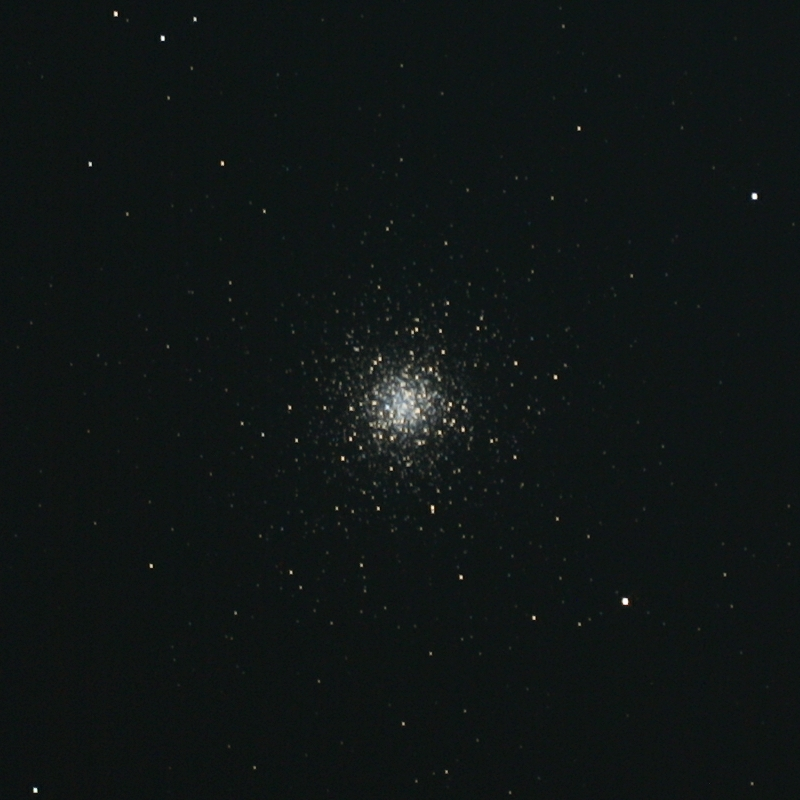
Globular Clusters


Globular clusters are dense groups of stars that orbit large galaxies, such as the Milky Way.  Studies indicate that the stars found in these clusters are very old.  There are over 150 known globular clusters orbiting our galaxy, and there may be as many as 180 to 200 total.

Most globular globular clusters are only 100 to 200 light years across, and may contain anywhere from 10,000 to a million stars. The stars are held within the cluster by their mutual gravity.  The density of stars per cubic area of space is very high, with as many as 100 to 1,000 stars per cubic parsec at the core!

The term "globular" comes from the Latin word, globulus, which describes the spherical shape of the clusters.

Several globular clusters are within the reach of amateur telescopes, and a few are even visible to the naked eye.  Charles Messier cataloged several of them.  I have imaged a few.  Due to various issues with the NJP mount, though, I do not consider all of my attempts successful.  Here, though, are the ones that I've kept:

Messier 3, in Canis Venatici; E-200; 52x15
Messier 13 and galaxy NGC 62 in Hercules; E-200; 7x120
Messier 22 in Sagittarius; E-200; 18x120