Showing posts with label Orion. Show all posts

Sunday, March 27, 2016

Sword of Orion

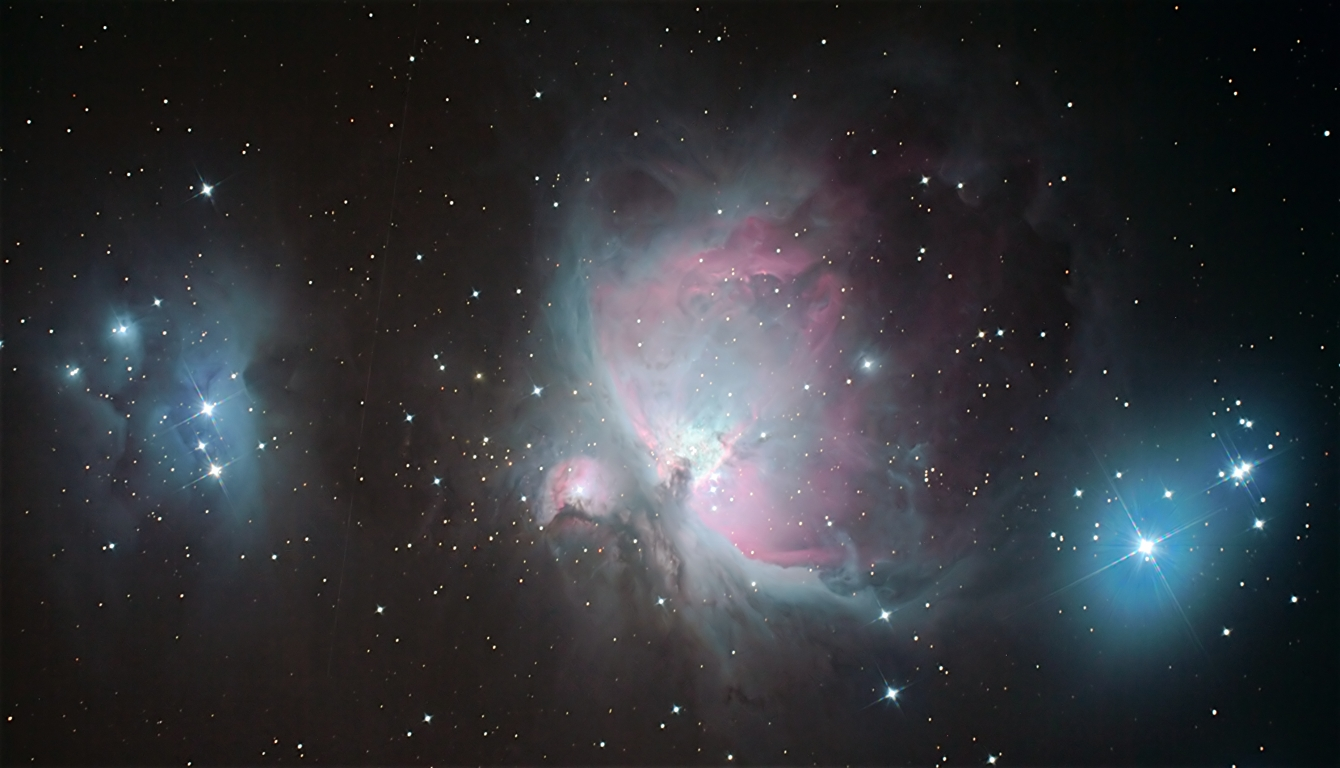
Yet another image of the Sword of Orion. I admit that it's one of my favorite targets, however, my primary purpose was to test how the Baader Contrast Booster performed.

The Moon rose around 10:00 PM, so my window was tight. I limited each set of exposures to 8 "good" subs each. The exposure times were 5, 15, 30, 60, and 120 seconds at ISO-3200. Images were stacked in Deep Sky Stacker with darks, flats, and bias frames, and then processed in Photoshop CS6 using the former Google Nik Collection.  (The current version of the Nik Collection can be found at DxO.)

Sword of Orion; ST80 w/Baader CB on Vixen SP; Canon EOS Rebel T3

Close-up of Messier 42 (right), the Great Orion Nebula, and Messier 43 (lower-left), De Mairan's Nebula.

Close-up of Running Man Nebula
The detail on this version isn't quite as sharp as my previous attempt. I think this may have been due in part to the seeing being poor (a front had come through the day before). More 120-second subs would have definitely helped.

The filter performed as expected. There was very little chromatic aberration, and I did nothing to remove what little there was. Note how the stars are not nearly so bloated as in the older image. Keep in mind that these images are from a relatively inexpensive achromat!

The distortion that is particularly noticeable in the stars on the left is due to coma.

Google recently made their Nik filter collection free to the public. There are tons of features and options, and I haven't explored them all. I used the Detail Extractor from the Color Efex Pro 4 collection and Dfine 2 noise reduction filters for these images. I was particularly impressed with the Detail Extractor as it brought out some very faint parts of the nebula in the lower part of the full-size image.

Thursday, February 11, 2016

Globe at Night, Part 2

My son and I collected some more sky brightness measurements on the night of February 9, 2016 in the vicinity of the small town of Bedias, Texas. Bedias is located in a rural area, surrounded by flat pastureland. There are many areas with views down to the horizon, or nearly so. Regretfully, there are several light domes that spoil what would otherwise be a spectacular view. Still, the skies there are fairly dark, at least at zenith.

The following two images were taken with the same equipment and settings as those in the previous post.

For reference, here is an image of the Orion constellation taken from my house the same night as the Bedias trip:

Orion at the ObservaRory
This image was taken on a county road near the western edge of Walker County, just a few miles east of Bedias.

A few miles east of Bedias, Texas. The red line to the left was from a passing aircraft.
The light dome of Houston, Texas and surrounding cities dominated the sky to the southeast. The light dome of Huntsville was visible to the east, and Madisonville's light dome was barely visible to the north.

While not as dark overall as the sky near Weldon, the view was very nice, with many faint stars visible to the naked eye at zenith, and the Milky Way clearly visible.

Thursday, February 4, 2016

Globe at Night

On the night of February 3, 2016, my son and I went on a little expedition to collect sky brightness measurements for the Globe at Night campaign. Globe at Night is a citizen-science project for raising public awareness of the effects of light pollution. Several times a year they host campaigns where participants observe a selected constellation and report how it appears in relation to a series of magnitude charts.

Our trip took us a few miles north of our house where, according to DarkSiteFinder.com, the sky brightness is rated around 3 on the Bortle scale.

The two images illustrate the difference in sky brightness between the ObservaRory (my house) and a location a little north of the town of Weldon, Texas. Both are 30-second exposures taken with a Canon EOS Rebel T3 with a 18-55mm zoom lens at 18mm (f/3.5) at ISO-1600. Both images are unprocessed, except to reduce their sizes.

Orion at the ObservaRory, about a mile north of the city limit of Huntsville, Texas.
The sky here is around 4.5 on the Bortle scale.

Orion north of Weldon, TX. The sky in this region measures 3 on the Bortle scale. Some of the light dome of Huntsville and a nearby prison unit are visible to the lower-left. Fainter objects, such as the Rosette Nebula, that are washed out by the skyglow in the previous photo are visible here.
To me, the most striking thing about the second image is the darkness of the background sky--there is no nauseating soup of mercury and sodium lights washing out the stars.

To learn more about light pollution and its effects on the environment, health, and energy consumption, I suggest the following links:

Wednesday, December 31, 2014

New Post, New Year, Another Redo

A few days ago I asked, "What do amateur astronomers do when the weather is lousy?" Today I ask, "What do amateur astronomers do when the weather is lousy, they have a cold, and they can't sleep?" Well, the answer is the same: they reprocess old images! So, I'm ringing in 2015 with a reprocess of images of the Horsehead and Flame Nebulae taken exactly four years ago today.

Flame Nebula (lower left) and Horsehead Nebula; ST80 on Vixen SP; Canon EOS Rebel XS (1000D); 12x180
Happy New Year!

Comet C/2014 Q2 (Lovejoy)

Famed amateur astronomer Terry Lovejoy discovered long period comet C/2014 Q2 in August 2014. It became visible at my latitude in December 2014, but the weather conditions afforded no decent opportunity to view it until the night of December 30/31. There was a lot a moisture in the air and the Moon was very bright (at 75% illumination), but the comet was naked-eye visible. Clouds were on the way, so I opted to quickly set up a DSLR on a tripod to try to capture a few images.

Maybe it's my imagination, but I can barely make out the comet's tail trailing to the upper-left. The stars are streaked due to the Earth's rotation. This was compiled from 5 8-second exposures at ISO-3200 using a Canon EOS Rebel T3 (1100D) with a zoom lens at 55mm.


This is a wide-angle image that shows the comet's location on the night of December 30th. Click on the labels for the indicated objects to open pages that give details. Some of the links will open pages on other web sites.

Horsehead and Flame Nebulae Sword of Orion Comet C/2014 Q2 (Lovejoy) Sirius (star)

Monday, December 24, 2012

Nebulae in Orion

My wife surprised me with an early Christmas present: a new lens for the DSLR. It's a 75mm-300mm zoom lens, so basically it is a small telescope in my view. It's not perfectly suited for the task, but that doesn't stop me from trying to use it for imaging. Below is my first attempt at using it for a wide-angle shot:

Nebulae in Orion
This is a composite of several exposures ranging from 10 seconds to two minutes.

The Sword of Orion is prominent in the upper-right. This complex of nebulae is composed of Messier 42, Messier 43, and the Running Man Nebula.

The Horsehead Nebula is located left of center. The horse's head is actually a molecular cloud, or dark nebula, situated in front of an emission nebula from our persepective.

The Flame Nebula, an emission nebula, is located to the left of the Horsehead.

The three bright stars that form a line from the Flame/Horsehead to the upper-left are Alnitak, Alnilam and Mintaka. They form the Belt of Orion.

Reflection nebulae Messier 78 is located in the lower-left of the image. I hope to get some better images of M78 in the near future.

Sunday, January 30, 2011

Sword of Orion on the ST80

The Sword of Orion is a group of open clusters and nebulae located south of Orion's Belt. The most prominent object in the Sword is the Great Orion Nebula, cataloged as Messier 42. The Great Orion Nebula is one of the few nebulae that are visible to the naked eye--the Lagoon Nebula is another.

I once imaged the Sword of Orion with the Epsilon-200, and the results were OK in my opinion. I intend to redo it on the Epsilon-200 when I get a chance. A while back I also imaged the Sword with my ST80 on the EQ-1 mount. Most of the subs were useless, and I only took 30-second exposures. The results were promising, though.

Last week I had the opportunity to re-image the Sword of Orion with the ST80. I used the Vixen GP mount and the Canon EOS Rebel XS camera. I had to take multiple images at different exposure times because the contrast among different parts of the nebulae is so great.  Here is the breakdown of sub-frames:

  • 10x1 second (that is, 10 one-second images)
  • 10x5 seconds
  • 10x10 seconds
  • 10x20 seconds
  • 23x60 seconds
  • 17x120 seconds
I stacked each group of exposures separately, then loaded the six final images as layers in GIMP. I brought out the detail in the brighter parts of the nebulae by using layer masks to cause the shorter-exposure images on lower layers to show through. (If anyone is curious how to do this in GIMP, send me a message and I'll explain in greater detail in another post.)

After the layer masks were complete, I flattened the image and then applied my usual fringe mitigation process.  (Again, e-mail me if you're curious how I remove the purple fringes from the stars.)

Here is the final product:

Sword of Orion, ST80 on Vixen SP, multiple exposures
There are several separately cataloged objects in the Sword. The group of stars on the left edge of the image is an open cluster that is cataloged as NGC 1981. To the right of that is the Running Man Nebula, which is a combination of diffuse nebulae NGC 1973 and NGC 1975, and open cluster NGC 1977. Near the middle of the image is De Mairan's Nebula, which is cataloged as Messier 43. To the right of that is Messier 42, The Great Orion Nebula. (To me, M43 looks like a bird's head, an M42 looks like the bird's body and wings.) Near the right edge of the image is diffuse nebula NGC 1980, which is illuminated by a 2.75 magnitude class B star called Na'ir al Saif (Arabic for "the Bright One in the Sword").

Wednesday, August 4, 2010

Orion

Orion is one of my favorite constellations. The Orion Molecular Cloud Complex (aka, the Orion Complex) is located within the constellation.  It is a vast nebula that spans hundreds of light years. Some parts of the nebula are visible in binoculars and small telescopes.

This wide-angle shot of the sky includes Orion and several neighboring constellations. The glow on the lower portion of the image is light pollution from Huntsville, TX.

Orion and Vicinity
Orion and Vicinity with Labels. (The Running Man nebula is mislabeled as Messier 43.)
There are several stories associated with the constellations around Orion. In one, Orion is defending himself with a club against Taurus, the bull. Sirius, one of his hunting dogs, has flushed out a rabbit, Lepus. Another story associates Taurus with the bull from whose hide Orion was born.

Most of the Orion Complex's features can only be seen through long-exposure imaging. One of these features is called Barnard's Loop, which is named after E. E. Barnard, the astronomer who is generally credited with having discovered it. Barnard's Loop is thought to have been formed by several supernovae. The gas is being ionized by several bright stars in the constellation, which gives the loop is red color.

Orion and Barnard's Loop
Orion and Barnard's Loop with Labels
The Sword of Orion is located below Orion's Belt.  It contains the Orion Nebula (Messier 42), De Mairan's Nebula (Messier 43) and the Running Man nebula. The Great Orion Nebula is visible to the naked eye as a fuzzy "star." Here is a close-up view of the Sword of Orion, taken with the Epsilon-200:

Sword of Orion, E-200, 11x10+4x30+10x60+6x120+4x180
I took this image of the Sword of Orion with my DSLR at prime focus on the ST80:

Sword of Orion, ST80, 23x30
The central part of the nebula is illuminated by a group of large, hot, young stars called the Trapezium Cluster. Below is a close-up of the Trapezium region:

The Trapezium Cluster
This is Messier 78, a reflection nebula. I was really surprised how well this image turned out because I shot it using my ST80 on the EQ-1 mount:

Messier 78, ST80, 7x30
And, finally, the Horsehead and Flame nebulae near the bright star Alnitak, in Orion's Belt:

Horsehead and Flame Nebulae, E-200, 16x180