Showing posts with label planets. Show all posts

Tuesday, December 22, 2020

2020 Jupiter-Saturn Conjunction

The much anticipated "Christmas Star" conjunction occurred on December 21, 2020. It was visible here at the ObservaRory for a few hours after sunset as clouds moved in and out. My wife and I got to share it with a few neighbors--social distancing was also observed! It was a real Dobsonian event!

To me, the best part of these sorts of things is that it sparks public interest in what is going on above. So many people never seem to look up, but who can really blame them? There is not much to see in the light-polluted skies where most people live.

The downside of these well-publicized events, though, is that they tend to be sensationalized and made out to be something that they are not. For example, a few people were expecting to see a bright star shining down on them like something out of a Christmas movie. The reality was considerably less spectacular, and difficult for some to even identify. Ironically, some people mistook Mars for the Christmas Star because it was more prominent in the sky.

But that aside, this was an event that none of us will see again in our lifetimes.

Well, sort of...

Planetary conjunctions are not that uncommon an occurrence. What made this one special was the apparent proximity of Jupiter and Saturn--it is not often one can fit two planets in the same field of view in a telescope. Objects in the sky have no variation in distance to the naked eye, so even though both planets are physically millions of miles apart, they appeared to be on a collision course from here on Earth. It is an out-of-the-ordinary thing to those who pay attention to the movement of the planets, but probably of little or no interest to individuals who keep their focus elsewhere.

OK, enough of my rambling thoughts. Let's get to some pictures.

Jupiter/Saturn conjunction; AT72EDII; Mallincam SkyRaider w/2X Barlow; SkyWatcher EQ6-R Pro mount; 215 frames; RegiStax 6, Photoshop CS6 (contrast enhancement, cropping)

My scopes are not well-suited for planetary imaging. An experiment that I performed the night before the event yielded disappointing results, so the night of the conjunction I decided to try using a 2X Barlow lens to magnify the scene and reduce the overall brightness. I think it worked out well considering the less-than-ideal circumstances. The Mallincam camera is monochrome, by the way, so none of these images are in color.

I was very happy that the camera picked up cloud bands in Jupiter's atmosphere. The contrast has been boosted but is still very poor because Saturn was not nearly as bright as Jupiter. To the left of Jupiter, and barely visible, are its moons Callisto and Io. Europa is to the right.

Mars; AT72EDII; Mallincam SkyRaider w/2X Barlow; SkyWatcher EQ6-R Pro mount; RegiStax 6, Photoshop CS6 (contrast enhancement and enlargement, cropping)

I slewed over to Mars on a whim, not thinking that I would see much. But, to my surprise, the image results were actually pretty good! I wish now that I had made the attempt to image Mars during the last opposition. I did not write down the number of frames that were stacked, but it was probably more than 100. This image has been enlarged.


Moon; AT72EDII; Mallincam SkyRaider w/2X Barlow; SkyWatcher EQ6-R Pro mount; 248 frames; RegiStax 6, Photoshop CS6 (contrast enhancement, cropping)

Moon; AT72EDII; Mallincam SkyRaider w/2X Barlow; SkyWatcher EQ6-R Pro mount; 215 frames; RegiStax 6, Photoshop CS6 (cropping)

How could I not take some pictures of the moon?

Those very few of you who follow this blog have probably noted my general absence over the past few years. Since the passing of my son, Patrick, my interest in hobbies has waned significantly. I feel, though, that I am starting to turn a corner. With the winter constellations now here, I hope to get back into imaging.


Saturday, July 25, 2015

Pluto

On the evening of July 14, 2015 I took a picture of Pluto to celebrate the flyby of Pluto by NASA's New Horizons spacecraft. But, there was a problem: I couldn't find it!

Pluto is very small, and also very dim. It is typically around 14th magnitude, which is about 128 times dimmer than the human eye can see in Earth's darkest skies. It's not even visible in most amateur scopes, outside of using long-exposure photography. In addition, the part of the sky that Pluto is currently located in is along part of the Milky Way. How was I to locate such a small, dim object among all of those stars?

Plan A was to use my various planetarium programs to find reference stars that would aid in locating Pluto. That failed because none of them had enough stars in their databases to account for everything I was seeing. I made an educated guess (which I discovered was correct), but there was no way to tell for sure until I could implement Plan B.

Plan B was to use a technique similar to that used by Pluto's discoverer, Clyde W. Tombaugh. Tombaugh worked for the Lowell Observatory in the 1920s and 1930s. He would select a part of the sky and take a picture of it with the observatory's 13-inch astrograph (a telescope designed for photography). A few nights later he'd take another picture of the same area. He then used a blink comparator to look for differences between the photographs. Objects that stayed in the same position were stars, but anything that moved was a comet, asteroid, or a planet.

I took my second set of images on the night of July 24, 2015. After processing and lining up the images I was able to see that my suspect Pluto was, in fact, the real thing! The animated GIF below shows Pluto's position on the two nights:

Pluto! Click on the image for a larger view.
To further illustrate how inconspicuous Pluto is, I put together this movie from the July 14th image:


So, there you have it. A mundane little dot moving among a sea of other dots. Who knew what a beautiful little world Pluto would turn out to be?

Public domain image courtesy of NASA and Wikimedia Commons.

Wednesday, December 24, 2014

Uranus

I found this shot of Uranus (center) while looking through some images that I took back in November 2013. It's nothing spectacular, but I thought the color was pretty. The star to the left of Uranus is labeled by Starry Night as TYC13-96-1 in Pisces.

Uranus; ST80 on Vixen SP; Canon EOS Rebel T3

Wednesday, July 10, 2013

Pluto

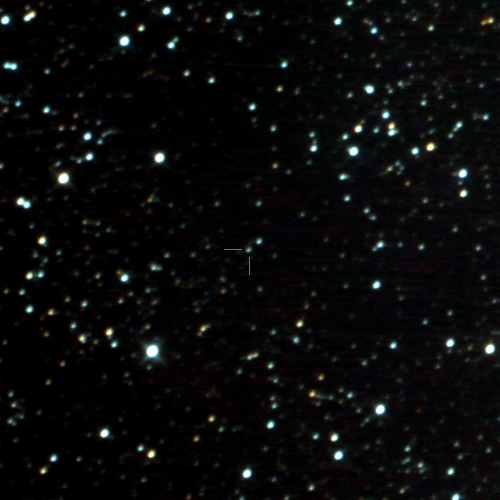
I was digging around in my archives and came across some images of Messier 24 from July 13, 2010. It occurred to me that Pluto would be somewhere within the image, and after some research and searching I managed to find it. It's the "star" at image center, indicated by the blue lines.

Pluto, July 13, 2010; Epsilon-200; Canon EOS Rebel XS (1000); 20x120
Another image from July 17, 2010 is located here.

Wednesday, May 29, 2013

Mercury-Venus-Jupiter Conjuction

I finally got a clear shot of the western sky to see the Mercury-Venus-Jupiter conjunction. This will be the closest grouping of these three planets until 2021.

Mercury is the faint "star" near the top-center of the image. Venus is the bright object near the center, and Jupiter is located below and slightly to the left of Venus.

Mercury (top), Venus (center) and Jupiter, May 29, 2013.
I was in the back corner of my yard taking pictures when the sprinklers went off. One sprinkler head was about 10 feet away. Out of it's nearly 360 degree field of rotation, guess exactly where it was pointing when it went off... Luckily the camera only got a glancing blow.

Tuesday, March 12, 2013

PANSTARRS and Moonset

My wife and I went up to the roof the Sam Houston State University parking garage to see the comet and take some pictures. A small crowd gathered around the telescope. Everyone seemed to have a good time. Below are some of the pics from tonight.

The star below and to the right of the comet is the planet Uranus:

Comet PANSTARRS; Canon Rebel T3 (1100D); ST80 on Vixen SP; 4 seconds at ISO-400
Click here for the full-size image

Comet PANSTARRS; Canon Rebel T3 (1100D); ST80 on Vixen SP; 5 seconds at ISO-1600
Click here for the full-size image

Setting Moon over Huntsville, TX; Canon Rebel T3 (1100D); ST80 on Vixen SP; 2.5 seconds at ISO-1600
Click here for full-size image
Here is a movie of the crescent Moon setting over Huntsville:

Saturday, November 24, 2012

Wide-Angle Shots

I've been experimenting with taking wide-angle long exposures with the camera mounted on the Vixen SP. Here is an image made in September 2012 of the Milky Way, with the constellation Cygnus on the left, and the constellation Aquila on the right. Prominent features include:

  • The North America Nebula, on the left.
  • The Great Rift (the dark lane that stretches across the middle of the image from left to right).
  • The Cygnus Star Cloud (the bright region just above the middle, from about the center of the image and extending to the left)
This image also encompasses part of the area that is being studied by the Kepler mission.

Note, too, that the Great Rift appears less dark on the right. This is due to light pollution from town.

Milky Way from Cygnus to Aquila; Canon EOS Rebel XS on Vixen SP mount; 15x240; click here for full size
The following was a test image made after focusing the camera on Jupiter during a brief imaging session in early November 2012. Jupiter is the bright star near the center of the image. The reddish star to the upper-right of Jupiter is Aldebaran, in the constellation Taurus. Also visible are star clusters NGC 1746 (which is actually an asterism partially composed of two open clusters), NGC 1647 and the Hyades cluster. The vertical streak is the light trail made by an airplane.

Jupiter; Canon EOS Rebels XS on Vixen SP mount; 1x30
After focusing the camera, I pointed it at Messier 31, the Andromeda Galaxy:

Messier 31, the Andromeda Galaxy; Canon EOS Rebel XS on Vixen SP mount; 6x150
My primary goal was to image the area surrounding the constellation Perseus. My time was running short and Perseus had just cleared the trees, so I pointed the camera in that direction and got enough subs for the image below. Some of the items visible here are the Double Cluster (above and right of center), and the Heart and Soul nebulae (the faint red patches below and left of center):

Perseus Region; Canon EOS Rebel XS on Vixen SP mount; 11x150; click here for full size

Friday, July 22, 2011

Antique Saturn

This rather poor image of Saturn was taken using a camera phone through the eyepiece of the Alvan Clark & Sons refractor at Sam Houston State University. The telescope was purchased in 1884 by the university (then known as Sam Houston Normal Institute) and sits on its original No. 5 mount. Mike Prokosch, the director of the SHSU Planetarium brought it out after a show one night to view the Moon and Saturn. The views were spectacular! Lunar features were crisp, with high contrast, and I could make out cloud bands on Saturn and the gap between the rings and planet quite easily.

A picture of Mike standing next to the telescope is located on Mike's web site.

Saturn; 1884 4.5" Clark refractor on No. 5 mount; Kyocera Loft camera through 0.6" eyepiece

Sunday, November 14, 2010

Looking for Faces in All the Wrong Places

Note:  This is a discussion of the Face on Mars. It will likely make some people angry. I believe that the "face" is a natural feature. This topic has been discussed to death by various individuals on both sides of the argument, but I thought I'd try my hand at it, anyway.


Images are courtesy of the European Space Agency. Yes, I'm using data from an ESA web site to discuss something that NASA did. Go figure.

The human brain is an amazing piece of engineering. Ironically, it is so complex that not even the human mind can't fully comprehend it, but significant progress has been made in decoding some of the brain's mechanical processes.

One of these processes deals with face recognition. Studies have shown that part of the brain's visual processing region, called the fusiform gyrus, is responsible recognizing and categorizing visual information. A specific area in the fusiform gyrus, known as the fusiform face area, seems to be responsible for recognizing human faces. Other studies have shown that this ability is already functioning at birth. Such mechanisms are essential for our survival, and most tend to stick with us throughout our lives.

And that's a good thing. Imagine what life would be like if you couldn't recognize friends, family, or even yourself. Unfortunately, there is such a condition. It's called prosopagnosia, and may involve damage to the fusiform face area.

Conversely, we often recognize faces where there are none. Pareidolia is a phenomenon where we see images and faces in things that are not related to the things we perceive. For example, most of us have recognized the shape of an animal or other thing in a cloud.

This ability has its advantages. It permits us to see through camouflage, pick out faces from a crowd, and produce interesting art.

But, it can easily be carried too far.

Take for example, the infamous Face on Mars.

While taking pictures of potential landing sites in 1976, the Viking 1 probe imaged the Cydonia region of Mars. One of the more intriguing features was a mesa that resembled a human face. As soon as the image became public people began to claim that the image was an artificial construction. It was hard to argue against what the eye was perceiving, though, until NASA was able to get higher resolution images nearly 25 years later.

I thought it might make an interesting exercise to show how the real feature can be mistaken for something that it's not, when the conditions are right.

First, here is the original Viking 1 image from 1976:


Yes, it's small. Actually, I think this is a slightly enlarged version of the original image. The resolution was very low--somewhere in the order of 150 to 300 meters per pixel. The pixels represent two types of things: luminance data, and missing data. Luminance data represents the brightness of the surface being imaged. Combine luminance pixels together and you get a black-and-white image. The missing data is just that: pixels that were lost in transmission.

Below is an image from the Mars Global Surveyor (MGS). This one has been scaled down to save space. A larger version is available here.


Big difference, huh? Well, the resolution of this image is MUCH higher, and the image was taken when the sun was higher in Cydonia's sky. It's still easy to see some parts of the face in the image, but, in my opinion, it certainly doesn't look as much like a face as the Viking 1 image.

For my little exercise, I reduced the MGS image to approximately the same size as the Viking 1 image:


Next, I simulated the shadows from the Viking 1 images by adjusting the contrast:


I thought that the image still had too much detail, so I blurred it a little:


Finally, I attempted to identify the missing pixels on the Viking 1 image and apply them to this image. This gives the face its right "nostril:"


OK, maybe it's not as impressive as the original Viking 1 image, but I think it still proves my point that it is easy to mistake one thing for another.

And this phenomenon isn't limited to just the "I-know-what-I-saw" and the I Want to Believe crowds. Famed astronomer Percival Lowell was convinced that there were canals--and therefore an advanced civilization--on Mars. And more recently one of my favorite astronomers thought he saw the ghost of Lenin on his shower curtain.  (OK, not really, but it sounds funnier that way.)

Still, despite the evidence, some people cling to the idea that the Face on Mars was made by some intelligent force. I admit its more fun to believe in space aliens, fairies, and that Andy Kaufman and Elvis are still alive. But, there are times when we need to face facts and move forward--and hanging onto a fantasy doesn't do anyone any good.

I think, instead, that we should focus our energy on finding out who or what created these interesting Martian features:

http://apod.nasa.gov/apod/ap990315.html
http://www.planetary.org/blog/article/00001314/

Friday, August 27, 2010

Jupiter and Moons

This composite image of Jupiter and the Galilean moons was created using the Epsilon-200 astrograph.  I had just finished imaging the moon and, on a whim, decided to see if the scope had enough magnification to pick up any details.  Surprisingly, it did.  It's nothing spectacular, but I thought it was kinda interesting.

Jupiter and Galilean Moons

Thursday, August 12, 2010

Moon and Planetary Conjunction

The Moon, Mercury, Venus, Mars and Saturn were grouped together tonight just after sunset.  Mercury was too low on the horizon for me to see, though.

August 12, 2010 Moon, Venus, Mars, Saturn Conjunction

Monday, August 2, 2010

The Planets, Plus One

Planets are tough to image. They are small, require a great deal of magnification, and often require filters to resolve fine details. Neither the ST80 nor the Epsilon-200 are suited for this purpose. The XT6 Dobsonian is pretty good at resolving planetary details visually for Mars, Jupiter and Saturn. There's not much to see when viewing Venus. Well, there is, but I haven't been able to see much.

I've come up with a trick, though, that lets me image some of the planets with my XT6 Dobsonian. Basically, I mount my Canon PowerShot A590 IS point-and-shoot camera afocally to a 9mm eyepiece (133X magnification). Then, I zoom in the camera to the highest optical zoom setting (4X). This gives me over 500X magnification. The target will move across the field of view very quickly. It takes a lot of work to get decent focus and to get the exposure time just right. The results are not outstanding, but hey, it's a cheap solution!

I've managed to image all eight of the planets, plus Pluto. (I'm not getting into a discussion as to whether or not Pluto is a planet!) Some images are simply shots of the sky, and some are close-up. Here they are in order from the Sun:

Mercury and Venus; DSLR on tripod; March 31, 2010
Venus; XT6; February 15, 2009
Because Venus orbits between us and the sun, we can see it go through phases similar to the moon. Venus is brightest in our skies when it is in a crescent or half phase because it is closer to us than at other times.

Earth; Dish Network; October 25, 2009
I meant it when I wrote "all eight planets!" The Dish Network satellite TV service has a channel called Dish Earth. It broadcasts a view of Earth from the Dish Network satellite in geostationary orbit 24 hours a day.

Mars; XT6; March 27, 2010
This image of Mars was taken about two months after the 2010 opposition. The lighter features at the top and bottom of the disc are the polar caps (north is at top). The darker feature near the bottom is called Tyrrhena Terra. It is a heavily cratered region that contains one of Mars' oldest volcanoes.

Jupiter, Io and Ganymede; XT6; July 4, 2009
The Great Red Spot is clearly visible here. The moons are, from left to right, are Io and Ganymede.

Saturn; XT6; April 02, 2009
This was my third, and best, attempt at imaging Saturn. One of the problems with trying to image with a telescope mounted on an alt-az base is that as objects move across the sky, they appear to rotate in the eyepiece. This effect was particularly pronounced with Saturn. The rings had "rotated" several degrees between the time I started imaging and the time that I stopped!

The following planets were all imaged with the Epsilon-200. The planets are far too small to render much detail within the E-200's field of view, though. My primary reason for imaging them was to simply say that I did it. Plus, I was hoping to catch a few moons, which I did!

Uranus and moons; E-200; July 17, 2010
Neptune and Triton; E-200; July 17, 2010
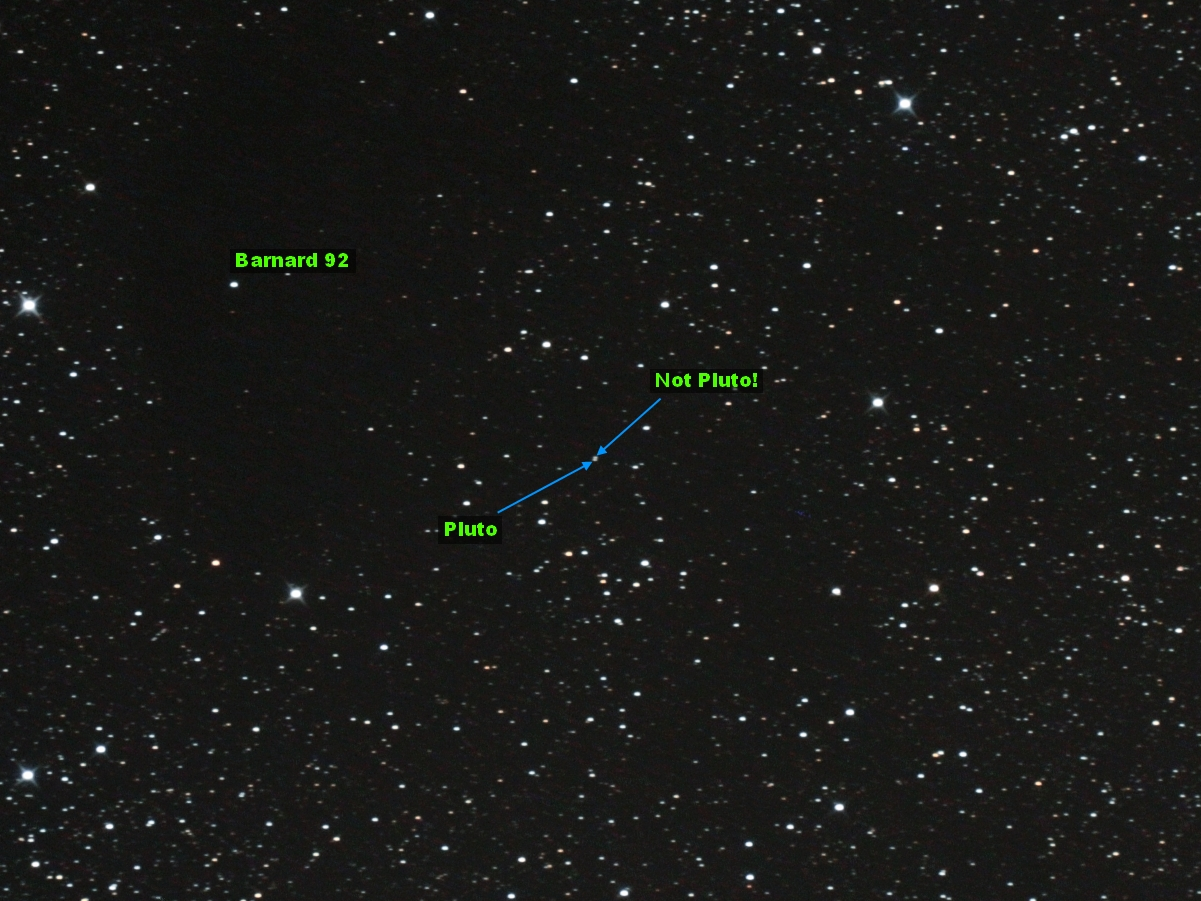
Pluto, near Barnard 92; E-200; July 17, 2010
Pluto passed in front of Barnard 92, a dark nebula, during mid-July 2010. Unfortunately, I missed that event.  I did catch Pluto, though, shortly after it had passed. It is right next to a star. It is easier to distinguish the two in the full-size image.