The transit occurred at 11:27:44 AM, and lasted about six tenths of a second. Considering it took nearly an hour to drive to the site and then almost a half hour to set up, this seemed like a small reward for the effort. But, it was very satisfying to see the space station race across the face of the Sun literally seconds after I had finished setting up and focusing the scope.
Composite of 11 separate images, combined and colorized in Photoshop CS6.
A 300% zoom of one of the better images in the series, showing some of the structural details.
Telescope: Coronado PST Mount: Vixen Super Polaris Camera: Mallincam SkyRaider AG Processing: MALLINCAMSKY, PIPP, Photoshop CS6
If you are in the right place at the right time you might be able to catch a glimpse of the International Space Station (ISS) as it passes in front of the Sun or Moon. These types of events are called "transits" and are fairly uncommon.
Transits are hard to see and easy to miss. The ISS orbits between 205 and 255 miles above the surface of the Earth, and moves at over 17,000 miles per hour. At that distance and speed, lunar and solar transits only last about one second or less and are only visible from a relatively narrow strip of land on the Earth's surface.
But finding a good viewing spot and time is relatively easy with ISS Transit Finder. This site lets you specify an area and a date range, and will calculate when and where the ISS will pass in front of the Sun or Moon.
A solar transit occurred on July 14, 2017. The center of the centerline of the transit was located in Lake Raven in Huntsville State Park, which is not far from where I live. I set up the ShortTube 80 with a full-aperture glass solar filter along the shore of the lake, and caught the transit using the Mallincam SkyRaider camera. Here is a composite image of the transit:
International Space Station transit of the Sun, July 14, 2017. Sunspot group AR2665 is located on the right.
The frame rate of the camera was not consistent, which is why there are gaps in the image sequence. The original monochrome images have been colorized to approximate the view through the solar filter.
The following video shows the transit in fairly close to real-time. Note that there are TWO transits! The first is probably an insect that either flew in front of the telescope or crawled across the objective lens.
On a side note, one of the lessons that I learned from the Venus Transit was that good polar alignment is critical for good results. This is difficult to do in the daytime, though, unless the mount has some kind of "magic" hardware and software for figuring out its exact position. My '80s-tech Vixen Super Polaris EQ mount does not have any fancy alignment features, but I was able to get a decent polar alignment using my mobile phone.
I plan on trying to image more ISS transits in the future when the opportunities arise. I would really like to get a lunar transit now.
Well, I almost missed it. Most of Texas (and the United States, for that matter) was socked in with clouds. The few places that were clear were too far for me to travel.
But amateur astronomers almost always hold on to at least a little bit of hope, even when the odds are overwhelmingly against us. We patiently scan the sky for "sucker holes" and engage in our preferred ritual superstitions to drive away the clouds. (Yeah, I know, we're supposed to be scientific and all that...but desperate circumstances often lead to desperate actions.)
The sky DID clear up for a few minutes--at least enough for me to focus and get a few shots in. It's nothing spectacular, but here it is:
Mercury is the dot to the upper-right of center. The big sunspot group to the left is AR2542. Other smaller sunspot groups are also visible.
This is a stack of four exposures, each 1/2000th of second at ISO-100, taken with a Canon T3 on my Orion ShortTube 80. I used an Orion full-aperture solar filter, and the Baader Contrast Booster (to reduce chromatic aberration). The images were stacked and wavelet sharpened in RegiStax5. I did an "auto color" correction in Photoshop CS6 to brighten the image a bit.
Click here to see my images of the 2012 Venus transit.
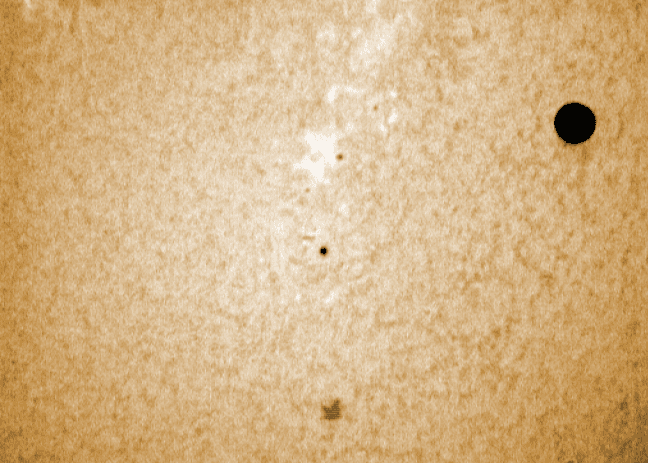
On June 5, 2012, the planet Venus passed directly between the Earth and the Sun for the last time until the year 2117. The weather here was favorable for viewing the first half of the transit. It was an amazing sight, and I'm very happy that my family and I got to see it!
Mike Prokosch and I set up our scopes on the grounds on the Texas Prison Museum and invited the public to come see the event. Here are some images that I took with my setup:
Hydrogen Alpha Images:
I used the Coronado PST and Meade DSI camera to capture these images of the Sun in the Hydrogen Alpha wavelength.
My personal favorite out of all of the images. Sunspot groups 1493 and 1496 are visible on the left.
Sunspot 1494 is on the far left.
Full-Spectrum Images:
These image were taken with a Canon EOS Rebel XS (1000D) attached to an Orion ShortTube 80 equipped with a solar filter.
Artsy Images:
Interesting Visitors
The following three images are single frames that captured other items besides the Sun and Venus. The first two show doubles, which gives some insight into how the Meade DSI camera works: it scans the odd- and even-numbered rows separately, allowing fast-moving objects to show up twice as they move across the field of view. Each of these images has been processed to make the transiting objects appear more solid.
Airplane. The contrails are visible as distortions behind the aircraft.
Bird, located below the sunspot that is near the center, and again to the right and slightly down.