And before the Moon got too bright, I took a few shots of the Double Cluster in Perseus. This is from 12 30-second exposures at ISO-6400, and minimally processed in GIMP.
Adventures in astroimaging and miscellaneous nonsense by an amateur astronomer in East Texas.
Sunday, January 19, 2014
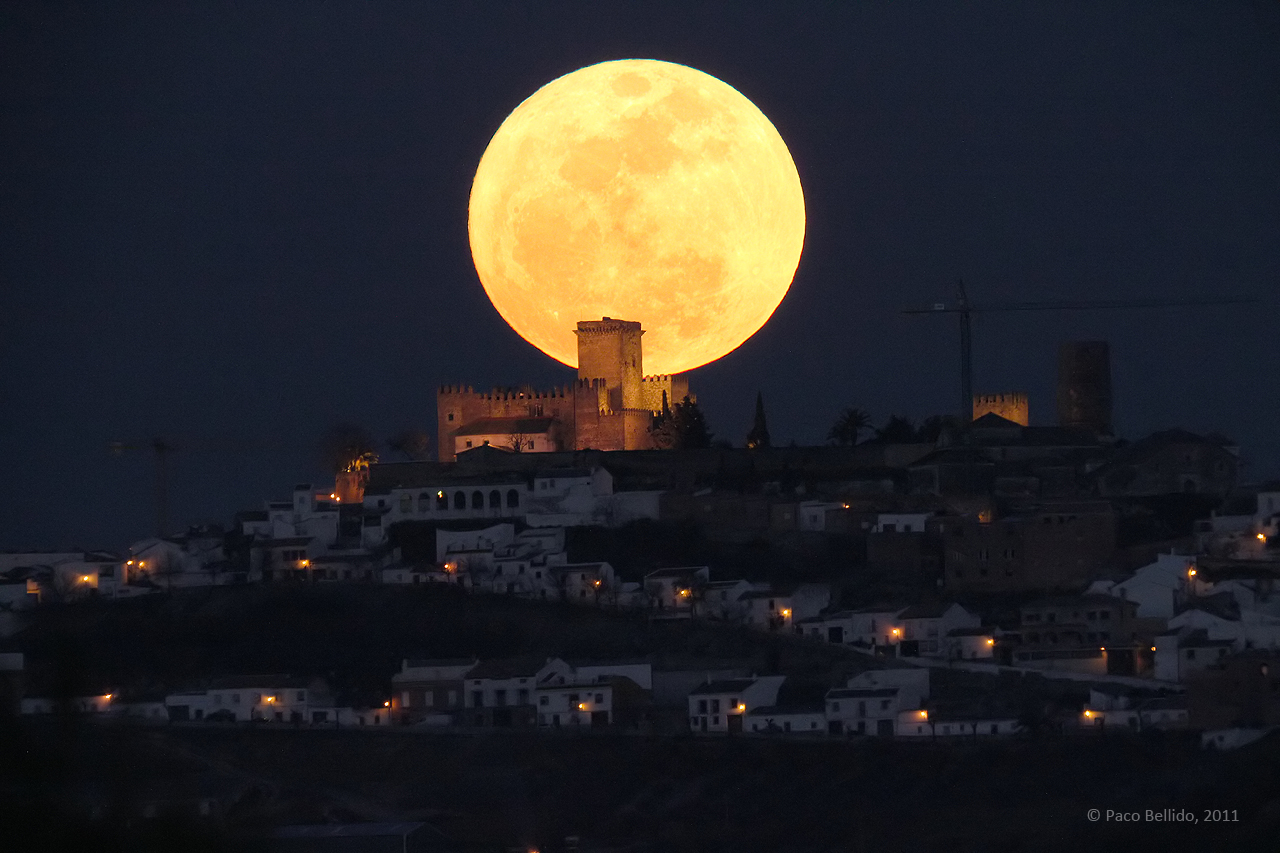
Rising Moon
You know those really cool pictures people take of the Moon rising behind interesting objects? I've been wanting to do something like that for a while, so I decided to go out and catch some shots of the rising moon from my front yard. The images are nothing spectacular, but there is something special about the Moon when it's low on the horizon...
I also took some quick shots of the Flame and Horsehead Nebulae in Orion while waiting for the Moon to rise. This image is composed from 7 30-second exposures at ISO-6400, and minimally processed in GIMP.
And before the Moon got too bright, I took a few shots of the Double Cluster in Perseus. This is from 12 30-second exposures at ISO-6400, and minimally processed in GIMP.
Sunday, January 12, 2014
2013 Parting Shots
Between the weather and various projects, I haven't had a lot of time to dedicate to astronomy recently. I did, however, set aside a few hours during some near-perfect conditions one night over the Christmas break. It turned out to be one of those rare sessions when nearly everything went perfectly--setup went quickly and smoothly, alignment was good, I found the targets quickly, and the images came out better than I expected.
This first image is of the Heart Nebula, IC 1805, located in the constellation Cassiopeia. This is a large and difficult target for my equipment. I was surprised that it turned out as well as it did. The brighter part in the lower-right corner is cataloged as NGC 896. It was discovered before the rest of the nebula. (The Index Catalog is an extension to the New General Catalog of Nebulae and Clusters of Stars, and contains many objects that were too dim to see when the NGC was made.)
This is the Monkey Head Nebula (NGC 2174), located in Orion. It surrounds open cluster NGC 2175. I don't see this object being imaged very often, so I figured that it would be fairly difficult to pick up on the camera. It was surprisingly bright, though. I really like the contrast between the red emission and white reflection regions.
One of my favorite images of the Monkey Head Nebula is located over at Polaris B.
This first image is of the Heart Nebula, IC 1805, located in the constellation Cassiopeia. This is a large and difficult target for my equipment. I was surprised that it turned out as well as it did. The brighter part in the lower-right corner is cataloged as NGC 896. It was discovered before the rest of the nebula. (The Index Catalog is an extension to the New General Catalog of Nebulae and Clusters of Stars, and contains many objects that were too dim to see when the NGC was made.)
![]() |
| Heart Nebula, IC 1805 (and NGC 896); ST80 on Vixen SP; Canon EOS Rebel T3; 15x120 at ISO-3200 |
This is the Monkey Head Nebula (NGC 2174), located in Orion. It surrounds open cluster NGC 2175. I don't see this object being imaged very often, so I figured that it would be fairly difficult to pick up on the camera. It was surprisingly bright, though. I really like the contrast between the red emission and white reflection regions.
![]() |
| Monkey Head Nebula (NGC 2174) and open cluster NGC 2175; ST80 on Vixen SP; Canon EOS Rebel T3; 18x180 at ISO-1600 |
Saturday, November 16, 2013
Comet C/2013 R1 (Lovejoy)
Lately, comet ISON has been getting a lot of attention in the press and among astronomers, but at present it is difficult to see because it is close to the horizon just before dawn. Comet C/2013 R1 (Lovejoy), however, is considerably higher up in the early morning sky at my latitude. It reached naked eye visibility in early November.
Comets are named using a convention that indicates the type of comet, and the year, half-month and order in which it was discovered. The discoverer's name is often included, and is sometimes used as the familiar name for the comet. This comet was discovered in September 2013 by famous amateur astronomer Terry Lovejoy. It is a long-period comet, with an estimated orbital period of over 10,000 years.
I made these images early in the morning on November 13. The first is a stack made in RegiStax 5 of 16 two-minute exposures centered on the comet core. The comet was moving rather quickly, so over time it moved a significant distance within my camera's field of view. As a result, aligning the images on the comet core caused the stars to trail.
Comets are named using a convention that indicates the type of comet, and the year, half-month and order in which it was discovered. The discoverer's name is often included, and is sometimes used as the familiar name for the comet. This comet was discovered in September 2013 by famous amateur astronomer Terry Lovejoy. It is a long-period comet, with an estimated orbital period of over 10,000 years.
I made these images early in the morning on November 13. The first is a stack made in RegiStax 5 of 16 two-minute exposures centered on the comet core. The comet was moving rather quickly, so over time it moved a significant distance within my camera's field of view. As a result, aligning the images on the comet core caused the stars to trail.
![]() |
| Comet C2013 R1 (Lovejoy); ST80 on Vixen SP; EOS Rebel T3; 16x120 at ISO-1600 |
The second image is a combined stack of four images using the comet stacking settings in Deep Sky Stacker. The program attempts to stack the comet and stars separately, then combine them.
It did a fair job of producing the image, but it washed out the color of the comet and left "holes" in the brighter stars. After a bit of work I got most of the color back and fixed the stars.
Although it does not have the detail of the first image, it looks better than a single frame.
It did a fair job of producing the image, but it washed out the color of the comet and left "holes" in the brighter stars. After a bit of work I got most of the color back and fixed the stars.
Although it does not have the detail of the first image, it looks better than a single frame.
![]() |
| 4x120 at ISO-1600, stacked in DSS using the "Comet and stars" stacking mode. |
Sunday, September 29, 2013
The Fireworks Galaxy and NGC 6939
I like finding objects that are close to one another in the sky like this interesting pair. Of course, they are many millions of light years apart from one another, but from our perspective they are neighbors. The spiral galaxy to the lower-left is cataloged as NGC 6946, but is more commonly known as the Fireworks Galaxy due to the unusually large number of supernovae recorded there in the past century. The Fireworks Galaxy is located along the border of the constellations Cepheus and Cygnus. Distance estimates vary between 10 and a little over 20 million light years away.
Open cluster NGC 6939 is considerably closer, at about 4000 light years, in the constellation Cepheus.
![]() |
| Fireworks Galaxy and NGC 6939; Canon EOS Rebel T3 (1100D); ST80 on Vixen SP mount; 16x120 @ ISO-3200 |
The Andromeda Galaxy
With good eyes at a dark location, you might see a faint smudge of light located about halfway between the Milky Way and the Great Square of Pegasus. This is our nearest galactic neighbor, the Andromeda Galaxy, also known as Messier 31. It spans an area in the sky several times the angular size of the Full Moon, but most people don't notice it. Regardless of this lack of notoriety among the general public, the Andromeda Galaxy is at least twice the size of our own galaxy, and appears to be heading straight toward us!
This is a difficult object to image due to its size. A patient person with enough time on his or her hands would do it in sections and build a mosaic. Not being particularly patient or possessing much time, I chose to do it in one series of shots. It barely fits within the field of view of my camera on the ST80; and since I do not have a field flattener there is a noticeable distortion on the edges. Still, I think this is my best one so far.
![]() |
| Messier 31; Canon EOS Rebel T3 (1100D); ST80 on Vixen SP mount; 20x120 @ ISO-3200 |
The Milky Way
This is a wide-angle image of the Milky Way that roughly encompasses the area between the constellations Aquila (lower-left) to Scorpius (upper-right), taken during the night of the 2013 Perseid Meteor Shower from the SHSU observatory.
Here is a close-up centered on the area around Sagittarius. Several prominent features are visible, including the Sagittarius Star Cloud (M24), the Eagle Nebula (M16), the Swan Nebula (M17), the Lagoon Nebula (M8), the Trifid Nebula (M20) and Messier 21, Ptolemy's Cluster (M7), the Wild Duck Cluster (M11), and Messier 22.
![]() |
| Milky Way; Canon EOS Rebel T3 (1100D), 18-55mm zoom lens at 18mm; Vixen SP mount; 15x120 @ ISO-1600, f/3.5 |
Here is a close-up centered on the area around Sagittarius. Several prominent features are visible, including the Sagittarius Star Cloud (M24), the Eagle Nebula (M16), the Swan Nebula (M17), the Lagoon Nebula (M8), the Trifid Nebula (M20) and Messier 21, Ptolemy's Cluster (M7), the Wild Duck Cluster (M11), and Messier 22.
Monday, September 23, 2013
Autumn Equinox 2013
The road in front of my house runs east-west, so I thought I'd try one of those sunrise or sunset equinox pictures. Today was the first full day of autumn in East Texas. The sky was overcast at sunrise, but I was able to get these pictures about 20 minutes before sunset.
![]() |
| Looking West shortly before sunset. |
![]() |
| Looking East, casting a long shadow. |
Subscribe to:
Posts (Atom)


.png)