Monday, March 12, 2012

A Little Sun

The Sun came out today! After several straight days of heavy rain and cloudy skies, I rushed outside after getting home from work and set up my telescope in record time. I only had about 15 to 20 minutes of imaging time before the Sun went behind some trees.

Here is a parting shot of infamous Active Region 1429, which has been hurling chunks of the Sun at us for the past week and half:

AR1429 (and sunspot 1430 above it)

The bright region below center is sunspot 1432.

The shadowy areas at top center and on the right of this image are tree limbs:
Sunspot region 1432 (top center) and sunspot 1433, below.
The Sun is going away, again, for a while. Hopefully it will come back out to play next week!

Monday, March 5, 2012

The Sun

I think I've gotten most of the kinks worked out of my solar imaging setup. Now I'm starting to learn how to take pictures with the Coronado PST and Meade Deep Sky Imager (DSI). I mentioned in my previous article that there was a lost of dust in the optical path. It turned out that the majority of it was in the camera, so it was easy to clean up.

There was a lot to see on the Sun today. Sunspot AR1429, which emerged this past Friday, unleashed a massive X-class solar flare late on March 4th, local time. The sunspot is visible in this image in the upper-right. Sunspot region 1428 is in the lower-right.

AR1429, upper-right; Sunspot region 1428, lower-right
Below is a more detailed view of the sunspots in AR1429. This image was generated using a different setting on the PST's filter tuner. This setting seems to filter out a lot of the finer details that are normally seen in Ha.

AR1429, left; Sunspot region 1430, right

This image is a little further "down" from the two above, and shows a solar prominence in the lower-left. Solar prominences are clouds of gas that are suspended above the Sun's surface by magnetic fields.

Sunspot region 1428, upper-right; A solar prominence, lower-left
Sunspot region 1423 is visible on the right side of this image. The dark streaks across the surface are called filaments. Filaments are the same as prominences, only seen from above. Another, smaller, prominence is located in the upper-right.

Sunspot region 1423, middle-right; Prominence, upper-right; Solar filaments
I have a lot of things that I want to try, time and weather permitting, before the Venus Transit on June 5th.

Sunday, February 26, 2012

Solar Photography - A Quick Experiment

A quick experiment with using an old Meade DSI camera and a 2x Barlow on the PST. There was a lot of dust in the optical path--mostly on the imaging chip, I think. I cropped out about 80% of the image to get a "clean" bit.

The DSI is a monochrome (black & white) camera. I colorized the image to make it look more "natural."


I need the skies to cooperate a bit so that I can spend some time working out how to do this stuff. So far the weather forecast doesn't look promising...

Saturday, February 25, 2012

Mercury, Venus, Jupiter and the Moon

Tonight, the Moon passed close to Venus. Mercury was right on the horizon, too!

Mercury, Venus, Jupiter and the Moon
Here is a labeled version of the above image:


Meanwhile, in other parts of the sky:

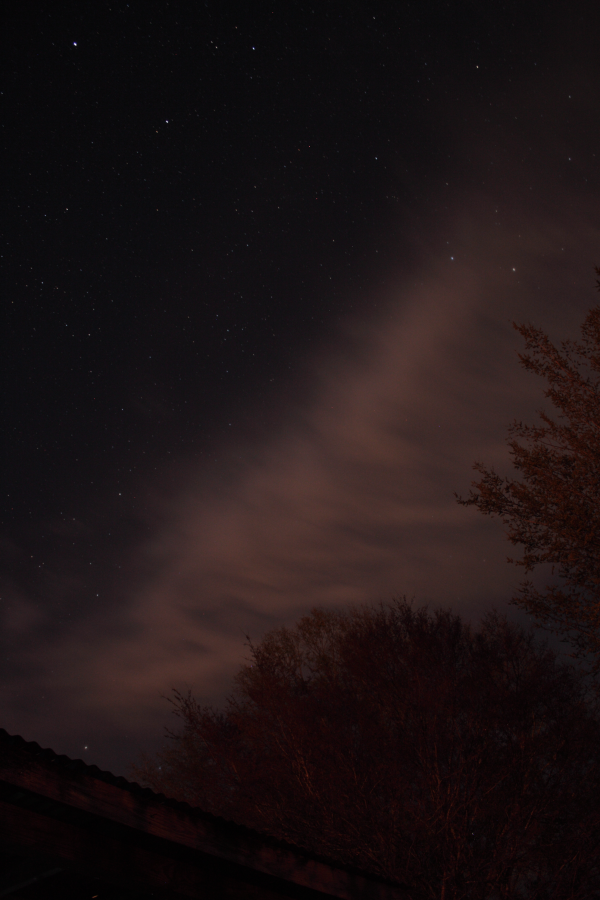
Dark cloud after sunset

High cloud illuminated by the last rays of the sun after sunset, passing in front of the constellations Auriga, Lynx and Ursa Major.

Sunday, January 29, 2012

The Sun

I recently gained access to a Coronado Personal Solar Telescope (PST). The PST is specially designed for solar viewing. It has a built-in filter for viewing Hydrogen Alpha (H-Alpha), which is one of the wavelengths of light emitted by hydrogen atoms that are being "stimulated" by ultraviolet radiation. It is one of the most common colors visible from stars since their outer layers are primarily composed of hydrogen atoms. H-Alpha is in the red part of the visible spectrum.

This morning I attached the PST to my Vixen Super Polaris mount and pointed it at the Sun. What I saw blew my mind! The detail was amazing! I could see prominences, the granular surface of the sun, and a sun spot with amazing clarity.

After trying various eyepieces I decided to see if I could take some pictures. Unfortunately, my Canon EOS Rebel XS won't come to focus in the PST's eyepiece tube. I was able to take some afocal shots, though, using the EOS Rebel and my Canon PowerShot A540.

Here are a few processed images, which certainly do NOT do justice to the naked-eye views.

This is a stacked image composed of 23 separate exposures taken with the Canon EOS Rebel XS. There was a lot of atmospheric turbulence, which may explain why the lower-right side of the Sun's disc appears slightly out of place. Note the prominences visible to the lower-left. The dark streaks across the face are probably prominences, as well. Some of the bright patches are plages.

I used a longer exposure time for the frames that were used to compose this image. Some of the features on the face are overexposed, but the relatively dim prominences along the limb are visible. In the future I will attempt to apply some High Dynamic Range techniques to even out the exposure.

This image was composed from several hundred frames from an AVI recorded with my Canon PowerShot A540.

Monday, January 2, 2012

Messier 41

Messier 41 is an open cluster in Canis Major (the Greater Dog). It can supposedly be seen with the naked eye in dark skies, but I have not been able to see it from here. This image was made under a fairly bright, moonlit sky.

Messier 41; Epsilon-200 on NJP; 25x60

New Year's Moon

Moon, January 1, 2012; Epsilon-200 on NJP; 30x1/250
This image is best viewed by opening it in a separate tab or window.