Sunday, July 21, 2013

Terrestrial Nebulae

In my opinion summers in this part of East Texas are not great for astronomy. Most are hot, dry and hazy. Some are hot, rainy and cloudy. This summer has been the latter. The forecast shows clear skies for the coming week, but the moon will be right around the full phase. Maybe we'll have better astronomy weather next month. In the meantime, I'm keeping myself entertained with the clouds, of which there are plenty to see. Here are some videos I made yesterday before, during and after a short rain shower.

Click on the images to load the videos. All of the videos are in Windows Media Video (WMV) format.

A cloud forms and dissipates from a column of rising air. I didn't have the camera set up correctly for this one, so the exposure times were variable, resulting in a sort of "blinking" effect. (2 MB)

Clouds form, a storm passes by. The big drops visible toward the end are from water dripping off of the roof. (7.8 MB)

Clouds forming after the rain. (2 MB)
You will probably notice a dot to the lower-right of center in all of these videos. I think there's a speck on my camera's imaging chip, but I have yet to find it.

Sunday, July 14, 2013

Clouds

When life hands you lemons, make lemonade, right? Clouds are the bane of astronomers, unless you're doing radio astronomy. It has been very cloudy here on the edge of the Piney Woods lately. Still, I think clouds are fun to watch. Click on the image below to load a Windows Media Video of a cloud boiling away. The video compresses about 25 minutes into 15 seconds. The file is about 11.4 MB.

A smaller version of the video (2.25 MB) is available here.

Wednesday, July 10, 2013

Pluto

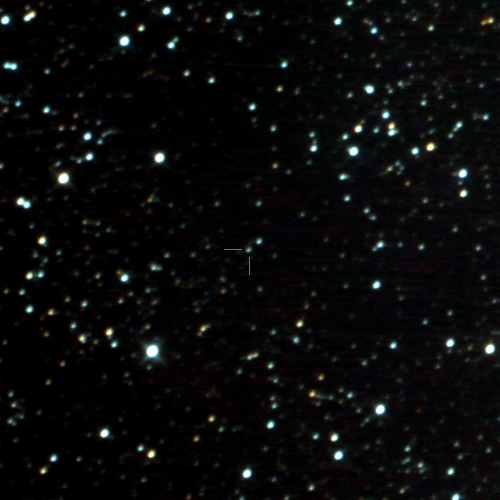
I was digging around in my archives and came across some images of Messier 24 from July 13, 2010. It occurred to me that Pluto would be somewhere within the image, and after some research and searching I managed to find it. It's the "star" at image center, indicated by the blue lines.

Pluto, July 13, 2010; Epsilon-200; Canon EOS Rebel XS (1000); 20x120
Another image from July 17, 2010 is located here.

Sunday, July 7, 2013

Observatory

The southern sky from my house is dominated by the light dome of Huntsville. One of the nice things about the Sam Houston State University observatory is its relatively dark southern sky; so, when I get a chance to image from the observatory I often image objects to the south.

During a recent visit to the observatory I imaged Messier 22, a globular cluster, and Messier 17, the Swan Nebula. Both objects are located in the constellation Sagittarius.  Both images were made with my ST80 and the Vixen Super Polaris mount.

Messier 22, the Sagittarius Cluster; ST80 on a Vixen SP mount; 17x120
I posted an image of Messier 22 back in August 2010 that was made using the Epsilon-200.

I was trying some experiments with a Barlow lens and apparently knocked the mount out of alignment.  I didn't realize the problem until I started imaging Messier 17. I tried realigning it, but apparently didn't do something right. It was getting late and I was getting tired and making mistakes. However, I did manage to get five decent subs of the nebula.
Messier 17, the Swan Nebula; ST80 on a Vixen SP mount; 5x120
I've imaged Messier 17 before. I will definitely revisit this object when I get a chance.

Monday, July 1, 2013

Messier 5

Messier 5 is a globular cluster in Serpens Caput (the Serpent's Head). It is one of the brighter globulars and is visible to the naked eye from dark locations.

For for those of you who are only interested in seeing the picture, here it is. Boring details about the imaging session are below. :)

Messier 5; ST80 on Vixen SP; 10x120 at ISO-800
Last night had nearly ideal viewing conditions, and I like to take any opportunity that I can to do some imaging or viewing, even if it's only for a short time. Fortunately the mount was already set up from the solar imaging session earlier that day, so I decided to work on improving my alignment skills.

Messier 5 was a good target for testing since it is fairly bright and was located near the celestial equator. As I've stated before, I use an old Vixen Super Polaris mount that was probably manufactured in the mid-1980s. The mount's polar alignment scope has an outdated reticle with a circle in which one is supposed to center Polaris. The circle is intersected by another circle that is drawn 48' from the center of the reticle, which represents the North Celestial Pole.  The position of Polaris has changed significantly due to precession, so I've had to estimate where to place Polaris in relation to the markings on the reticle. Until last night my attempts have been anywhere from bad to not quite so bad.

I downloaded an app named Polar Finder for my Android phone. It features an iOptron reticle that makes it easy to pinpoint where Polaris should be in my Vixen finder scope. I estimated the location in the reticle, aligned the mount, and then took 23 two-minute exposures.

The results were pretty good! There was a little bit of drift, but the main problem was just periodic error, which I have no control over, anyway. The image below is a combination of all of the exposures made in Startrails. It illustrates how much the mount moved off target during the session.

23 images combined in Startrails, showing the effects of periodic error and misalignment.
The stars are streaked up and down due to periodic error. I expected to see something more like the oscillations captured during the 1998 QE2 imaging session, but apparently the alignment was very good. I think that the small "hook" to the right was due to vibration or wind affecting the mount. I'm looking forward to trying this again and taking long exposures on some galaxies and nebulae!

Sunday, June 30, 2013

Sun

It's been a while since I've done any solar imaging. I found that I enjoyed imaging in Hydrogen Alpha when I was preparing for the Venus Transit last year, but I don't have the right equipment. I borrowed a Coronado PST this weekend and managed to get a few images between the clouds.

All three images were made using the Coronado PST. The first two were imaged with a Meade DSI camera, and the third was imaged with a Canon EOS Rebel T3 (1100D). I was able to capture a separate set of images for the solar disk in the first image, which is why the details are more pronounced than in the second image.

Solar Prominences

Solar Prominences

The full disk of the Sun, taken with my DSLR.

Saturday, June 22, 2013

Supermoon 2013

About once every 14 lunar months the Moon reaches perigee with the Earth at about the same time that it enters the Full phase. We call these events Supermoons. There's nothing intrinsically special about this occurrence. The Full Moon appears slightly larger than other Full Moons, and will be noticeably brighter to those who are used to seeing it often. But as far as its effects on Earth are concerned, there is very little to mention except that we humans like to make a big deal out of it.

Still, it's a good excuse to take pictures.

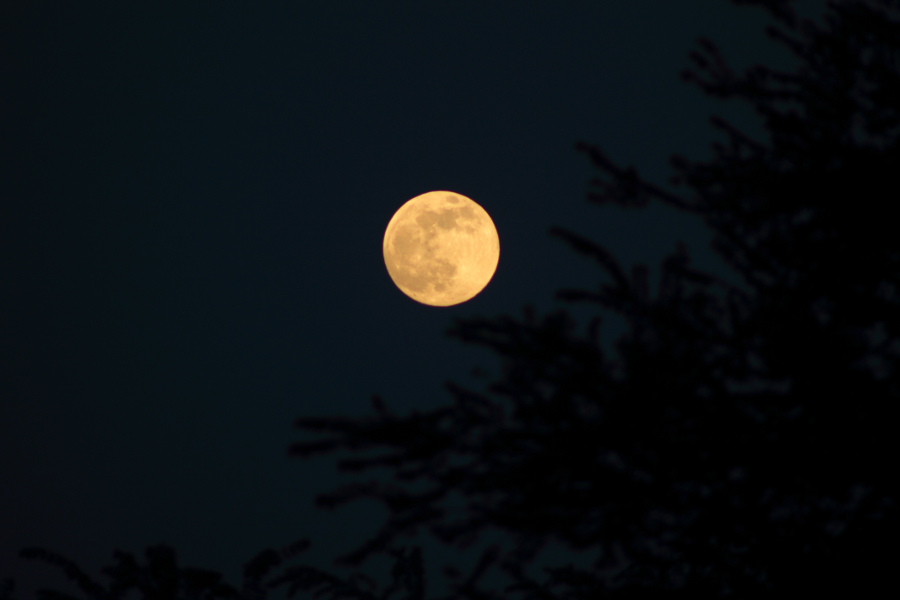
Here are a couple of snapshots taken of the 2013 Supermoon as it rose over the trees in my neighborhood. My neighbor across the street was kind enough to let me use her yard since the Moon is completely blocked from view in mine until it gets about 30 degrees above the horizon.

Supermoon 2013
Canon EOS Rebel T3, f/7.1, 1/400 sec, ISO-3200, 300mm focal length

Supermoon 2013
Canon EOS Rebel T3, f/5.6, 1/100 sec, ISO-200, 300mm focal length