Sunday, September 4, 2011

The Server Farm

I was a Database Administrator (DBA) in my previous job. We were a highly specialized shop in most respects, which means that different individuals handled specific tasks. For example, as a DBA I was not allowed to set up virtual servers or allocate resources to existing servers, and I had limited authority to make configuration changes at the operating system level. As a result, I sometimes found it difficult to guarantee system integrity. This lead to a lot of personal stress, so as a stress-relief exercise I made light of a particular series of events that occurred during my last year of employment. I shared this story with my coworkers in bits and pieces as the events unfolded and they found it entertaining, so I thought I'd share it with the world at large.

I've included some additional commentary to help explain the circumstances a little better.


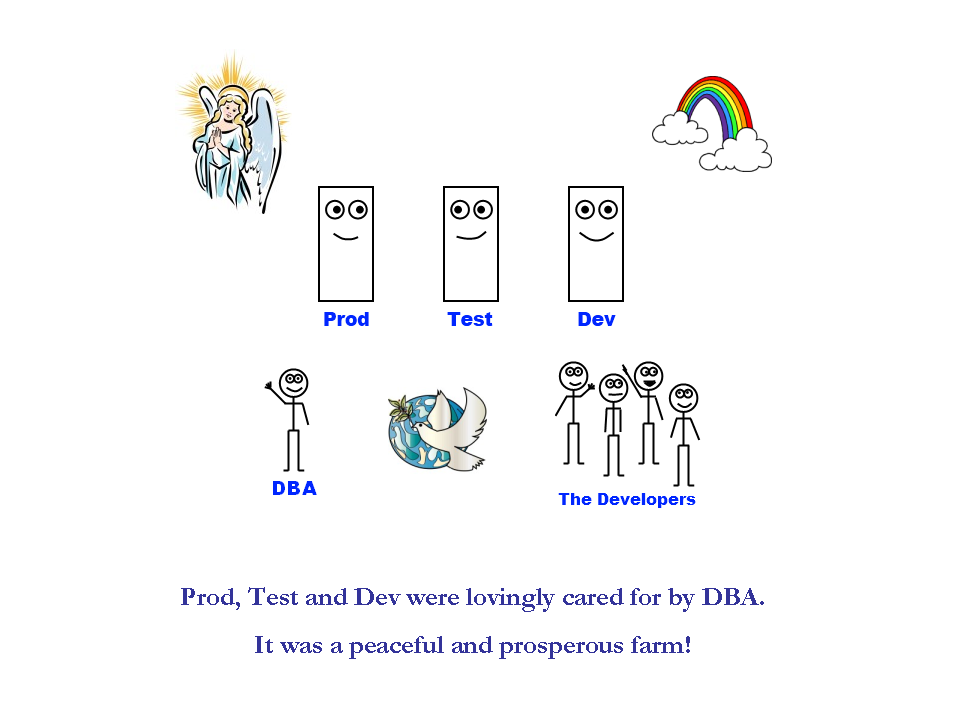

Mainframe had a database that was one of the primary sources of information used by my employer.  Directly accessing the mainframe for daily reports was impractical because of performance issues.  I used the DRDA gateway to copy the relevant data into the Prod database on a regular basis and ran the reports from there.

The conversation between me and the Network Person went something like this:

NP:  "Are you using Test?"
Me:  "No.  I am not doing any testing today.  Do you need to take it off-line?"
NP:  "Yes."

I interpreted this conversation to mean "We, the Network People, need to reboot Test because we are using it for some nefarious purpose of our own, such as World Domination."  It was a perfectly reasonable assumption since both the Network People and I used this particular server for a variety of testing purposes.  What the Network Person really meant was, "We, the Network People, are going to reformat Test's hard drive and turn this machine into a menial Zombie Slave."


Reports was brought on-line for a single user who did a lot of complex queries and reporting.  It was determined by our administration that this individual should have a separate database in which to work.  Reports was supposed to be simple:  one machine would have all of the necessary tools, including the database, running in an easy-to-use GUI operating system.


I never did find out why Reports and Mainframe couldn't get along.


Most of Dev was set up to parallel Prod, so it was a fairly easy operation to "graft" Dev to Prod. Still, it made me look like a Genius Miracle Worker to most of my peers. (Those who didn't think I was a Genius Miracle Worker probably didn't understand the setup, anyway.)


Starting at this point, Reports was only used for hosting the database. The reporting tools were installed on a different server.

There was a long period of time between the slide above and the slide below. We had to coast along like this for a while because other projects had to take precedence.


Certain batch processes on the mainframe would lock entire tables, causing Prod's jobs that read those tables to time out. The scheduling of the mainframe batch processes seemed to change unpredictably.


Well, that's the end as far as I'm concerned. My successor will need to pick up the standard and carry it forward into the battle now. I wish him or her all the best.

Friday, July 22, 2011

Antique Saturn

This rather poor image of Saturn was taken using a camera phone through the eyepiece of the Alvan Clark & Sons refractor at Sam Houston State University. The telescope was purchased in 1884 by the university (then known as Sam Houston Normal Institute) and sits on its original No. 5 mount. Mike Prokosch, the director of the SHSU Planetarium brought it out after a show one night to view the Moon and Saturn. The views were spectacular! Lunar features were crisp, with high contrast, and I could make out cloud bands on Saturn and the gap between the rings and planet quite easily.

A picture of Mike standing next to the telescope is located on Mike's web site.

Saturn; 1884 4.5" Clark refractor on No. 5 mount; Kyocera Loft camera through 0.6" eyepiece

Tuesday, June 28, 2011

Reprocessed Images and Something New

The recent lousy weather (for astronomy) has kept me indoors for some time now, and when that happens, I sometimes dig into the archives to see what I can reprocess.

Messier 27, the Dumbbell Nebula, was the first thing I imaged with the Epsilon-200. For some reason, I recorded all of the subs in JPEG format instead of CR2 (RAW). Regardless, I was very happy with the original image at the time. I've learned a few tricks for reducing noise, though, so I thought I'd take another stab at it:

Messier 27, the Dumbbell Nebula
For comparison, see my previous post of Messier 27.

I've never been very happy with my image of Messier 17, the Swan Nebula. Like my M27, I only collected JPEG images. The images were very noisy, which made it difficult to bring out the fainter details of the nebula without swamping the rest of the image in colored streaks. A program like Neat Image can be your friend in those circumstances.  Here is a redo of M17:

Messier 17, the Swan Nebula
And, finally, here is a "new" image of Messier 8, the Lagoon Nebula, that I imaged some time ago. I think this is the first time that I've posted it in a public forum:

Messier 8, the Lagoon Nebula; Epsilon-200 on NJP; 17x120

Saturday, June 11, 2011

Supernova 2011dh

On May 31, 2011, amateur astronomer Amédée Riou of France discovered a supernova in Messier 51, the Whirlpool Galaxy. It was independently discovered by other astronomers shortly afterward, and is currently being observed by professional and amateur astronomers world-wide.

Below is an image that I took of M51 on June 8, 2011. A first-quarter moon was up and the sky was hazy, so the detail isn't that great. The supernova, now designated SN 2011dh, is as bright as many of the foreground stars in this image. Considering that M51 is 23 million light years away, that's pretty bright!

SN 2011dh in M51; ST80 on Vixen SP; 14x180
For comparison, here is a shot of M51 that I took with the Epsilon-200 on April 24, 2010, reduced and rotated to approximately the same size and orientation as the image above.


Below is the full-size version of the Epsilon-200 image. The moon was about 85% full that night, but the sky was much clearer than the other night.

Messier 51, the Whirlpool Galaxy; Epsilon-200 on NJP; 25x120
SN 2011dh is expected to remain visible for the next few months. It has been determined to be a Type II supernova, which means that it was caused by giant star that collapsed in upon itself. The debris from this star will be scattered into interstellar space and may end up becoming the raw material for new stars and planets. The core of the star likely collapsed into either a neutron star or a black hole.

SN 2011dh is the third supernova observed in M51 in the past 17 years, which is a remarkably high frequency considering that our own galaxy averages only one supernova every 50 years!

Thursday, May 26, 2011

Lightning!

Here are some shots of lightning taken from my back porch on May 25, 2011.


Friday, May 6, 2011

Star Trails

This is a star trail image taken from my front yard. The stars are seen here "swirling" around the North Celestial Pole (NCP), which is located near the bottom of the image. The bright star near the NCP is Polaris, the North Star.

Located about one third of the way between the NCP and the upper-right corner of the image are two bright trails that were formed by Kochab and Pherkad. They form part of the bowl of the Little Dipper. The bright stars at the top of the image are part of the Big Dipper.

The light trails of several aircraft and a few satellites are also visible.

This image is a composite of 282 30-second exposures (2.35 hours total). They were combined with a neat little program called Startrails.

Star Trails around the NCP; Canon EOS Rebel XS (1000D); 282x30